Maintaining focus in 2026 requires more than willpower. The modern workplace demands strategic tools that combine behavioral science with sensory optimization. An app for focus serves as a digital companion, transforming how professionals approach concentration and mental clarity through evidence-based methodologies. These applications have evolved beyond simple timer functions, integrating acoustic research, cognitive training, and habit formation into comprehensive focus ecosystems.
The Science Behind Focus Applications
Neuroscience reveals that sustained concentration operates on specific brainwave patterns. When you engage in deep work, your brain shifts into alpha and theta wave states that promote cognitive efficiency. Modern focus applications leverage this understanding by creating environments that facilitate these neural transitions.

Acoustic Engineering and Cognitive Performance
Sound therapy has emerged as a validated approach to enhancing focus. Acoustic researchers have identified specific frequency ranges and ambient patterns that reduce cognitive load while maintaining alertness. Unlike generic music playlists, scientifically designed soundscapes incorporate:
- Pink noise frequencies that mask distracting environmental sounds
- Binaural beats calibrated to promote alpha wave dominance
- Nature-based ambient layers that reduce cortisol levels
- Rhythmic consistency that supports task rhythm and flow states
Research demonstrates measurable improvements in task completion rates when individuals work within optimized acoustic environments. The best app for focus integrates these principles directly into its sound library, offering collections specifically engineered for different work modalities.
Behavioral Frameworks for Sustained Attention
Applications designed for concentration must address the behavioral component of focus. Micro-habits represent the most sustainable approach to building attention capacity over time. Rather than forcing extended focus sessions, effective applications guide users through progressive skill development.
| Micro-Habit Category | Duration | Target Skill |
|---|---|---|
| Attention anchoring | 2 minutes | Present-moment awareness |
| Task transitioning | 5 minutes | Context switching efficiency |
| Focus recovery | 3 minutes | Distraction management |
| Deep work preparation | 7 minutes | Mental state optimization |
These incremental practices compound over weeks, fundamentally restructuring how your brain approaches concentration challenges. An app for focus that incorporates behavioral training transforms from a passive tool into an active coaching system.
Essential Features in Modern Focus Applications
The landscape of focus applications has matured significantly. Professional-grade tools now combine multiple disciplines to address concentration from various angles simultaneously.
Sound Collections and Acoustic Libraries
A comprehensive app for focus provides curated sound environments matched to specific work contexts. Freshhh.app exemplifies this approach by collaborating with acoustic researchers to develop soundscapes that support different cognitive demands. Their collections include:
- Deep focus soundscapes for analytical work requiring sustained concentration
- Creative flow environments that balance stimulation with mental spaciousness
- Calm clarity tracks for detail-oriented tasks and review sessions
- Transition sounds that prepare your mind for different work modes
These aren't arbitrary playlists. Each collection undergoes testing to verify its impact on measurable focus metrics like task completion time and error rates.
Practical Tips and Training Modules
Sound alone cannot build lasting focus capacity. The most effective applications integrate research-based tips that educate users on concentration mechanics. Understanding why certain techniques work increases compliance and long-term adoption.
Freshhh.app distinguishes itself by positioning as a focus companion rather than just an audio player. The platform includes practical guidance on environmental optimization, scheduling strategies for peak cognitive performance, and techniques for managing attention during challenging work periods. This educational component transforms user behavior beyond the immediate session.
Distraction Management Systems
Modern focus apps recognize that blocking distractions represents only one dimension of concentration management. Sophisticated systems teach users to recognize distraction patterns and develop intrinsic resistance.
Rather than simply blocking websites, advanced applications help users understand their unique distraction triggers. They provide frameworks for addressing the underlying causes, whether those stem from task anxiety, boredom, or insufficient challenge level.
Comparing Focus Application Approaches
Different applications emphasize distinct methodologies. Understanding these philosophical differences helps professionals select tools aligned with their concentration goals.
Restrictive vs. Supportive Frameworks
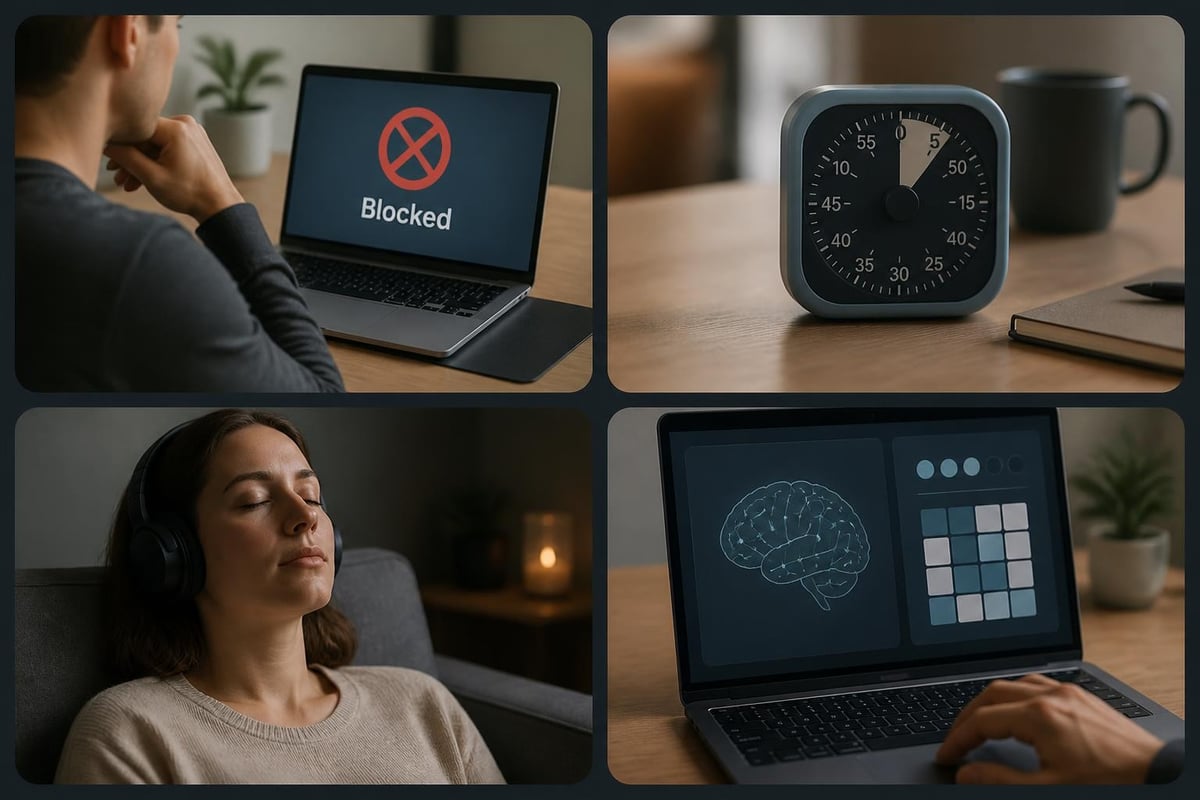
Restrictive applications operate through limitation. They block access to distracting websites, lock your phone, or restrict application usage during designated periods. These distraction blockers serve specific use cases but don't develop internal focus capacity.
Supportive frameworks build cognitive skills that transfer across contexts. An app for focus using supportive methodology provides:
- Environmental optimization through sound and sensory cues
- Skill development via progressive concentration training
- Awareness cultivation that improves distraction recognition
- Habit integration that embeds focus practices into daily routines
Freshhh.app operates within the supportive framework, training your mind rather than simply controlling your environment. This approach develops transferable skills that improve focus even when you're not using the application.
Timer-Based vs. Adaptive Systems
The Pomodoro Technique popularized timer-based focus sessions. While effective for structure, rigid timing doesn't accommodate natural cognitive rhythms or task variability.
Adaptive systems recognize that different work requires different attention patterns. Complex problem-solving might demand 90-minute blocks, while administrative tasks benefit from shorter bursts. Advanced applications provide flexibility while maintaining accountability.
| System Type | Strengths | Limitations |
|---|---|---|
| Timer-based | Clear structure, easy compliance | Interrupts flow states, ignores task variability |
| Adaptive | Matches natural rhythms, task-appropriate | Requires more self-awareness, potential for rationalization |
| Hybrid | Combines structure with flexibility | More complex to implement |
The optimal app for focus offers both structured sessions and adaptive options, allowing users to match methodology to current needs.
Sound Therapy Integration for Peak Performance
Acoustic optimization represents the frontier of focus technology. The relationship between sound and concentration operates through multiple mechanisms that extend beyond simple distraction masking.
Frequency-Specific Cognitive Enhancement
Different brainwave frequencies correlate with distinct mental states. Gamma waves (30-100 Hz) associate with high-level information processing. Beta waves (12-30 Hz) support active thinking and focus. Alpha waves (8-12 Hz) facilitate relaxed concentration and learning.
Sound therapy applications can encourage specific brainwave patterns through:
- Isochronic tones that pulse at target frequencies
- Binaural beats creating perceived frequencies through stereo separation
- Harmonic layering that naturally resonates with desired brain states
- Ambient soundscapes that reduce beta wave dominance during stress
Freshhh.app develops soundscapes with explicit brainwave targets, ensuring each collection serves a specific cognitive function. This precision separates therapeutic sound environments from generic background music.
Environmental Sound Masking
Open offices and home environments introduce unpredictable acoustic disturbances. The brain allocates significant processing power to monitoring environmental sounds, reducing capacity for primary tasks.
Effective masking requires specific acoustic characteristics. Pink noise and brown noise provide broader frequency coverage than white noise, creating more natural sound barriers. Nature sounds leverage evolutionary adaptations that make certain ambient patterns cognitively soothing rather than demanding.
A properly designed app for focus combines masking efficiency with listening comfort. Hours-long sessions require sounds that don't create listener fatigue or become irritating through repetition.
Building Focus Capacity Through Micro-Habits

The most sustainable improvements in concentration come from habit formation rather than willpower. Micro-habits work because they require minimal activation energy while creating neurological pathways that strengthen over time.
Attention Training Sequences
Effective focus applications guide users through progressive skill development. Initial exercises might involve:
- Single-breath awareness to establish present-moment anchoring
- Environmental scanning to practice deliberate attention direction
- Thought labeling to develop meta-awareness of mental wandering
- Attention returning to build the recovery skill after distraction
These practices take 2-3 minutes but fundamentally improve attention control. Freshhh.app integrates such exercises into session preparation, ensuring users don't just listen to sounds but actively train concentration capacity.
Habit Stacking for Focus Routines
Habit stacking attaches new behaviors to existing routines, leveraging established neural patterns. An app for focus that teaches stacking techniques helps users embed concentration practices into their day without requiring additional willpower.
Examples of effective focus stacks include:
- Morning work initiation: Open laptop → Start focus app → Complete 2-minute centering exercise → Begin primary task
- Post-lunch energy dip: Return from break → Choose calm clarity soundscape → Review task list → Resume work
- Context switching: Complete current task → 3-minute transition sound → Brief environment reset → New task initiation
These sequences become automatic over weeks, reducing the mental effort required to enter focused states.
Measuring Focus Application Effectiveness
Subjective feelings of improved focus don't always correlate with performance gains. Professionals benefit from applications that provide objective metrics and progress tracking.
Quantifiable Concentration Metrics
Advanced focus applications track multiple dimensions of attention performance:
- Session duration to measure sustained focus capacity
- Distraction frequency to identify improvement in attention stability
- Task completion rates within focus periods
- Recovery time after interruptions
These data points reveal patterns that inform both application usage and broader productivity strategies. Understanding that focus capacity peaks during specific times enables better task scheduling.
Long-Term Skill Development Tracking
The true value of an app for focus emerges over months as cognitive skills compound. Applications should demonstrate progress through:
- Baseline comparisons showing initial vs. current attention capacity
- Trend visualization revealing gradual improvements in focus metrics
- Milestone recognition that reinforces positive behavioral change
- Adaptive challenge that increases difficulty as skills improve
Research on mindfulness apps demonstrates measurable mental health improvements when users engage consistently over 8-12 weeks. Similar principles apply to focus training applications.
Integration with Productivity Ecosystems
An app for focus doesn't operate in isolation. Professional workflows involve multiple tools for task management, note-taking, communication, and scheduling. The most effective focus applications integrate seamlessly with existing productivity ecosystems.
Complementary Tool Relationships
Focus applications work alongside rather than replacing other productivity tools:
- Note-taking apps capture ideas and information during focus sessions
- Project management systems provide the task structure that focus sessions execute
- Calendar applications schedule protected focus blocks based on energy patterns
- Communication tools enable "focus mode" status to manage expectations
Freshhh.app recognizes this ecosystem reality by providing a specialized function: training your mind and optimizing your acoustic environment. It doesn't attempt to become a comprehensive productivity suite, instead excelling at its core competency.
Workflow Integration Strategies
Effective integration requires intentional design. Successful workflows might include:
- Morning planning in project management tool
- Session initiation in focus app with appropriate soundscape
- Work execution using relevant task-specific applications
- Break protocols guided by focus app recommendations
- Session review noting completed tasks and focus quality
This structured approach ensures the app for focus serves its purpose without creating additional complexity or context switching.
Selecting the Right Focus Application for Your Needs
Different professional contexts and personal preferences require different focus solutions. Comprehensive reviews of focus apps can provide starting points, but individual experimentation remains essential.
Evaluation Criteria for Professional Use
When assessing focus applications, consider:
- Primary methodology: Does it block, guide, or train?
- Sound quality: Are soundscapes professionally produced and research-based?
- Educational component: Does it teach focus skills or just provide tools?
- Flexibility: Can it adapt to different work modes and contexts?
- Evidence basis: Are claims supported by research or testimonials?
Freshhh.app positions itself uniquely by combining sound therapy with cognitive training. Rather than simply providing ambient noise, it develops your focus capacity through research-based tips and micro-habits while offering acoustically engineered soundscapes.
Trial Periods and Experimentation
Most focus applications offer trial periods. Use this time to assess:
- Actual usage frequency versus intended usage
- Measurable impact on work output and quality
- Subjective experience of focus and mental clarity
- Integration ease with existing workflows
Track specific metrics during trials. Compare focused work output during weeks with and without the application to identify genuine value beyond placebo effects.
The Future of Focus Technology
Focus applications continue evolving as neuroscience research advances and technology capabilities expand. Understanding emerging trends helps professionals anticipate next-generation tools.
Personalization and Adaptive Intelligence
Future applications will leverage behavioral data to create increasingly personalized experiences. Machine learning algorithms can identify individual focus patterns, optimal session lengths, and most effective sound environments.
Adaptive soundscapes might automatically adjust based on:
- Detected stress levels through device sensors
- Time of day and circadian rhythm patterns
- Task complexity and cognitive demand
- Environmental noise requiring different masking approaches
These capabilities transform an app for focus from a static tool into a responsive companion that learns your unique attention profile.
Multimodal Concentration Support
Sound represents one sensory dimension. Advanced applications may integrate:
- Visual environment optimization through screen color temperature and brightness
- Haptic feedback for attention anchoring and distraction alerts
- Air quality monitoring since CO₂ levels impact cognitive performance
- Posture guidance recognizing the connection between physical state and mental focus
These multimodal approaches address concentration holistically, acknowledging that focus emerges from the interaction of multiple factors.
Practical Implementation Strategies
Acquiring an app for focus represents the first step. Consistent implementation determines actual benefit. Successful adoption requires intentional strategy.
Building Sustainable Usage Habits
Application abandonment typically occurs within the first two weeks. Counter this pattern by:
- Starting minimal: Use the app for one focus session daily rather than attempting whole-day transformation
- Anchoring to existing routines: Attach app usage to established behaviors like morning coffee or post-lunch work resumption
- Tracking compliance: Note usage in your calendar or habit tracker to maintain awareness
- Celebrating progress: Acknowledge successful sessions to reinforce positive associations
Freshhh.app supports this gradual adoption by offering quick-start micro-habits that require minimal time investment while delivering noticeable benefits.
Optimizing Your Focus Environment
The best app for focus works synergistically with environmental optimization. Enhance effectiveness by:
- Controlling lighting to reduce eye strain and support circadian rhythms
- Managing temperature since thermal discomfort diverts cognitive resources
- Organizing workspace to minimize visual clutter and decision fatigue
- Using quality headphones to maximize sound therapy benefits
- Establishing boundaries with colleagues or household members during focus blocks
These environmental factors compound the benefits provided by focus applications, creating comprehensive concentration ecosystems.
Adjusting Based on Work Type
Different cognitive demands require different focus approaches. Analytical work benefits from longer sessions with minimal interruption. Creative work might require more flexible timing with space for divergent thinking. Administrative tasks can use shorter bursts with task batching.
An effective app for focus accommodates these variations through multiple sound collections and session structures. Freshhh.app provides distinct soundscapes matched to different work modes, recognizing that no single approach serves all professional contexts.
Modern professionals face unprecedented attention challenges that require sophisticated solutions. The right app for focus combines acoustic science, behavioral training, and practical implementation support to develop genuine concentration capacity rather than just blocking distractions. By integrating sound therapy with micro-habits and research-based techniques, you can transform how your brain approaches sustained attention. Freshhh.app offers exactly this combination-science-backed soundscapes developed with acoustic researchers, alongside practical tips and micro-habits that train your mind for deeper focus and mental clarity. Start building your concentration capacity today with a tool designed to develop lasting cognitive skills.