
Finding great music for studying can transform your productivity and focus during learning sessions. The right soundscape doesn't just mask distractions-it actively supports cognitive function, enhances memory retention, and creates an optimal mental environment for information processing. Understanding which musical elements support concentration helps you build a study routine backed by acoustic science rather than guesswork.
The Science Behind Study Music and Cognitive Performance
When searching for great music for studying, understanding the neuroscience behind sound and focus provides crucial insights. Research demonstrates that specific musical characteristics interact with brain wave patterns to either enhance or diminish concentration. The tempo, instrumentation, and structural complexity of music all influence how effectively your brain processes and retains information.
Brainwave entrainment occurs when rhythmic auditory stimuli synchronize with neural oscillations. Music with 60-90 beats per minute naturally aligns with alpha brain wave states associated with relaxed alertness. This tempo range, often found in lo-fi hip-hop and classical adagios, creates an ideal backdrop for sustained attention without causing overstimulation.
The absence of lyrics plays a significant role in maintaining focus. Linguistic content activates language processing centers in the brain, competing for cognitive resources needed for reading, writing, and comprehension tasks. Instrumental compositions eliminate this interference, allowing your working memory to allocate full capacity toward study material.
How Musical Structure Affects Memory Formation
Great music for studying incorporates predictable patterns without becoming monotonous. Repetitive elements provide structural stability that helps reduce decision fatigue, while subtle variations maintain enough interest to prevent mental drift. This balance keeps your attention anchored without demanding active listening that would distract from your primary task.
Ambient textures and minimalist compositions excel at creating what researchers call "optimal arousal levels." These soundscapes provide enough auditory stimulation to prevent boredom while avoiding the cognitive load that complex musical arrangements impose. The result is sustained focus that feels effortless rather than forced.

Top Genres That Constitute Great Music for Studying
Different musical genres offer distinct advantages depending on your learning style, task type, and environmental needs. Various music genres affect concentration in measurably different ways, making genre selection a strategic decision rather than mere preference.
Classical Music: The Mozart Effect and Beyond
Classical compositions have dominated study music recommendations for decades, partly due to the well-publicized Mozart Effect. While initial claims about IQ enhancement were overblown, classical music does provide legitimate cognitive benefits through its structured complexity and emotional neutrality.
Baroque period compositions particularly shine as great music for studying. Works by Bach, Vivaldi, and Handel feature steady rhythms around 60 BPM, mathematical precision in structure, and instrumental richness that engages attention without overwhelming it. The predictable patterns support focus while the artistic depth prevents monotony during extended study sessions.
- Piano solos by Chopin and Debussy
- String quartets from Mozart and Haydn
- Orchestral suites with moderate tempos
- Chamber music featuring woodwinds
Lo-Fi Hip-Hop: Modern Study Companion
Lo-fi hip-hop has emerged as exceptionally great music for studying among contemporary learners. These tracks combine mellow beats, jazz-influenced harmonies, and atmospheric elements into soundscapes specifically designed for concentration. The genre's characteristic features include consistent tempos, minimal vocal samples, and nostalgic textures that create comfort without distraction.
The intentional imperfections in lo-fi production-vinyl crackle, slightly detuned instruments, ambient room noise-paradoxically enhance focus by creating an intimate, familiar atmosphere. This aesthetic helps many students feel less isolated during solo study sessions while maintaining the acoustic properties necessary for concentration.
Ambient and Electronic Soundscapes
Ambient music pioneers like Brian Eno designed their compositions explicitly as background environments rather than foreground entertainment. This philosophy makes ambient genres inherently great music for studying. Long, evolving tones, sparse instrumentation, and absence of rhythmic emphasis allow the music to fade into the background while subtly supporting mental clarity.
Electronic ambient sub-genres offer additional variety:
- Drone ambient: Sustained tones that create meditative focus
- Field recordings: Natural soundscapes integrated with musical elements
- Atmospheric electronica: Synthesized textures with minimal percussion
- Space music: Expansive compositions that encourage mental openness
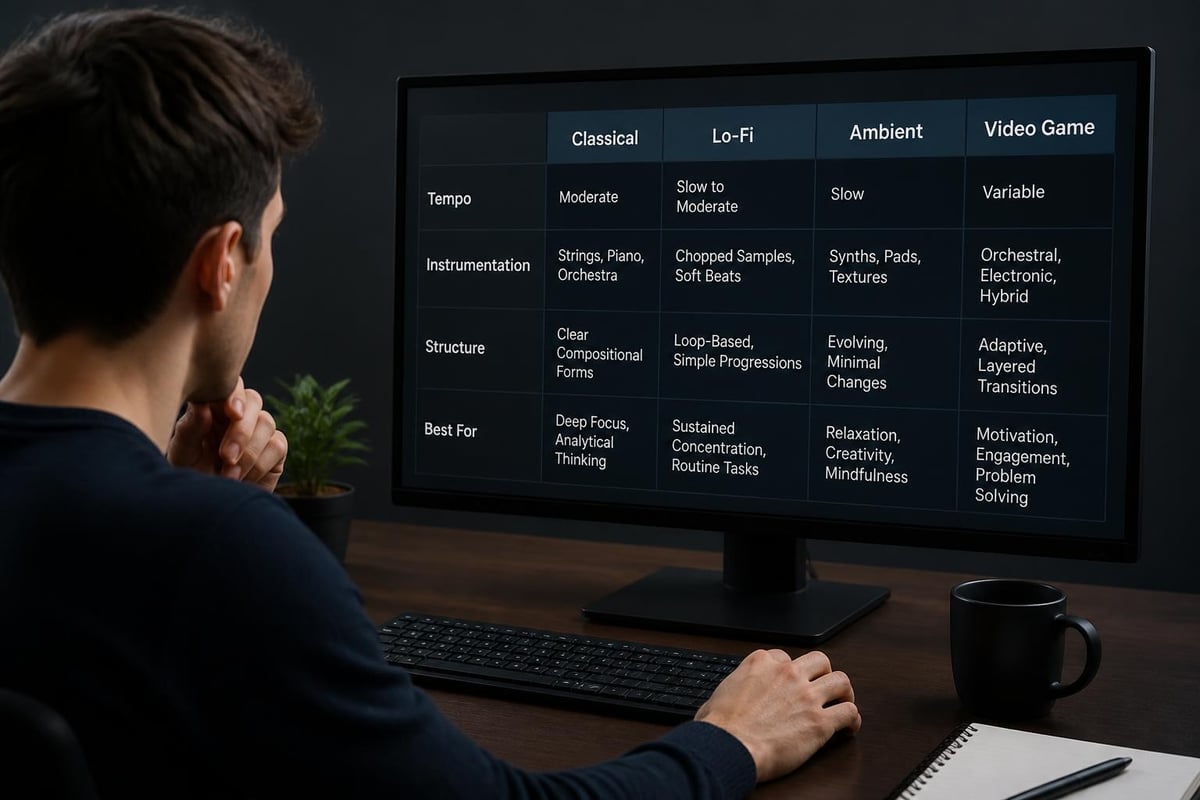
| Genre Category | BPM Range | Primary Benefits | Best For |
|---|---|---|---|
| Classical Baroque | 60-80 | Structured thinking, mathematical reasoning | Analytical tasks, problem-solving |
| Lo-Fi Hip-Hop | 70-90 | Sustained attention, creative flow | Reading, writing, general study |
| Ambient Electronic | 50-70 | Deep focus, stress reduction | Complex comprehension, memorization |
| Video Game OST | 80-110 | Engagement, task completion motivation | Repetitive tasks, test preparation |
Video Game Soundtracks: Engineered for Extended Focus
Game composers face a unique challenge: creating music that maintains player engagement during hours of repetitive tasks without causing fatigue or distraction. This makes video game soundtracks surprisingly effective as great music for studying. Games like Minecraft, Stardew Valley, and The Legend of Zelda feature atmospheric scores designed to enhance concentration during problem-solving.
The functional nature of game music aligns perfectly with study needs. These compositions reward sustained attention, support pattern recognition, and create positive emotional associations with focus-intensive activities. Many students report that game soundtracks trigger productive mental states through associative conditioning.
Optimizing Your Study Music Selection Strategy
Selecting great music for studying requires matching acoustic properties to specific cognitive demands. Not all study tasks benefit equally from the same musical accompaniment. Research on focus music effectiveness reveals that task complexity and novelty determine optimal sound environments.
Matching Music to Task Type
For memorization and rote learning, choose music with minimal variation and slower tempos. Ambient drones or simple piano compositions prevent interference with verbal memory formation while maintaining enough presence to block environmental distractions.
For creative writing and brainstorming, slightly more dynamic compositions support associative thinking. Lo-fi beats or impressionistic classical pieces provide rhythmic structure without imposing rigid constraints on mental exploration.
For mathematical and logical problem-solving, baroque classical music or structured electronic compositions complement analytical thinking patterns. The mathematical precision in these genres may prime cognitive frameworks useful for systematic reasoning.
For reading comprehension, prioritize silence or extremely subtle ambient textures. Complex musical elements compete for the same neural resources engaged in language processing, potentially reducing retention and understanding.
Volume and Acoustic Environment Considerations
Great music for studying operates at specific volume ranges to maximize benefits. Research suggests background music should remain at 50-60 decibels-about the level of normal conversation in the next room. This threshold provides masking benefits for environmental noise without becoming a primary focal point.
The acoustic properties of your study space interact with music selection. Reverberant rooms with hard surfaces benefit from softer, warmer recordings to prevent harsh reflections. Carpeted spaces with sound-absorbing materials accommodate brighter, more detailed productions without acoustic fatigue.
Consider these volume and environment combinations:
- Library or quiet room: Lower volume (40-50 dB), detailed classical or ambient
- Coffee shop or shared space: Moderate volume (55-65 dB), masking-focused lo-fi or electronic
- Home with intermittent noise: Adaptive volume, nature sounds integrated with music
- Dorm room or busy household: Noise-canceling headphones, immersive soundscapes
Building Effective Study Playlists and Routines
Creating great music for studying extends beyond individual track selection to playlist architecture and listening habits. The sequence, duration, and consistency of your study soundscape significantly impact its effectiveness over time.
Playlist Duration and Flow Design
Optimal study playlists run 90-120 minutes, matching natural ultradian rhythms-the biological cycles that govern attention span. This duration supports complete focus sessions without requiring conscious intervention to restart or change music, which disrupts concentration flow states.
Progressive energy mapping structures playlists to match cognitive demands across study sessions:
- Opening 15 minutes: Gentle entry tracks establishing focus baseline
- Middle 60-90 minutes: Consistent tempo and texture maintaining concentration plateau
- Final 15 minutes: Gradual energy reduction supporting transition out of study mode
Avoid shuffle modes during study sessions. The predictable progression in curated playlists creates temporal landmarks that help gauge time passage without clock-checking, supporting better time management and reducing anxiety about session duration.
Consistency and Associative Learning
Using the same or similar playlists repeatedly trains your brain to associate specific soundscapes with focus states. This Pavlovian conditioning makes entering concentration easier over time as the music itself becomes a trigger for productive mental states. Great music for studying becomes more effective through repeated exposure as these associations strengthen.
Rotation strategies prevent habituation while maintaining associative benefits:
| Strategy | Description | Benefits | Implementation |
|---|---|---|---|
| Core + Variation | 70% consistent tracks, 30% rotated weekly | Strong associations with novelty prevention | Keep 7-10 anchor tracks, swap 3-4 contextual pieces |
| Themed Collections | Separate playlists for different subjects or tasks | Task-specific mental priming | Create 3-5 distinct playlists mapped to study categories |
| Seasonal Refresh | Complete playlist overhaul every 2-3 months | Prevents complete habituation, maintains engagement | Archive effective playlists for future reuse |
| Dynamic Layering | Base ambient track with rotating melodic elements | Stability with controlled variation | Use apps allowing multiple simultaneous soundscapes |

Emerging Research on Personalized Sound Therapy
The frontier of great music for studying moves beyond generic genre recommendations toward personalized acoustic interventions. Individual differences in auditory processing, attention regulation, and stress response mean optimal study soundscapes vary significantly between learners.
Binaural Beats and Frequency-Based Approaches
Binaural beats deliver slightly different frequencies to each ear, creating a perceived third frequency that may influence brain wave patterns. While commercial claims often exceed scientific evidence, emerging research on focus music suggests moderate benefits for some individuals when binaural beats align with target cognitive states.
Alpha frequency binaural beats (8-12 Hz) theoretically promote relaxed alertness ideal for studying. Theta frequencies (4-7 Hz) may support deep learning and memory consolidation. However, individual responses vary considerably, making personal experimentation necessary to determine effectiveness.
Adaptive Soundscapes and Real-Time Adjustment
Advanced approaches to great music for studying incorporate biometric feedback and environmental sensors. These systems adjust tempo, texture, and volume based on heart rate variability, movement patterns, or ambient noise levels, theoretically maintaining optimal acoustic conditions as circumstances change.
While still emerging, adaptive music systems in collaborative workspaces demonstrate promise for individual study applications. The technology remains nascent but suggests future directions for truly personalized focus soundscapes.
Common Mistakes to Avoid with Study Music
Even when selecting genres proven as great music for studying, implementation errors undermine potential benefits. Understanding common pitfalls helps maximize the cognitive advantages of strategic sound use.
Excessive Complexity and Familiarity
Overly complex music engages active listening rather than supporting background focus. Intricate jazz improvisations, progressive rock compositions, or dramatic symphonic works demand attention that should direct toward study material. Similarly, extremely familiar music triggers memory associations and emotional responses that pull awareness away from current tasks.
The sweet spot for great music for studying balances enough interest to prevent mind-wandering with sufficient neutrality to avoid becoming a distraction. Music should fade into unconscious awareness during peak focus while remaining present enough to mask environmental disruptions.
Lyrical Content in Any Language
Many students believe foreign-language lyrics avoid the distraction of English words. However, the human brain processes all vocal patterns as potential linguistic content, activating language centers regardless of comprehension. Instrumental versions of favorite songs prove more effective than foreign-language alternatives for maintaining focus during language-intensive study tasks.
Volume Creep and Acoustic Fatigue
A common pattern sees students gradually increasing volume as they habituate to initial levels. This "volume creep" leads to acoustic fatigue-a state of auditory system stress that impairs concentration and creates tension headaches. Starting sessions at slightly lower volumes than preferred prevents this escalation pattern.
Recovery strategies for acoustic fatigue include:
- 5-minute silence breaks every 45-60 minutes
- Rotating between headphone and speaker listening
- Alternating detailed and minimal soundscapes
- Monitoring for early fatigue signs (jaw tension, ear pressure)
Integrating Music with Comprehensive Focus Strategies
Great music for studying achieves maximum impact when integrated with broader concentration techniques rather than used in isolation. Acoustic optimization represents one element within multifaceted approaches to cognitive performance.
Environmental Design Beyond Sound
Visual complexity, lighting temperature, spatial organization, and thermal comfort all interact with auditory environments. Music genres effective for concentration work best within holistically optimized study spaces. Harsh fluorescent lighting or cluttered visual fields can override benefits from perfect soundscapes.
Multisensory coherence matters more than individual element optimization. Cool-toned lighting pairs well with minimal ambient music, while warmer environments complement slightly more energetic lo-fi selections. Your acoustic choices should harmonize with rather than contradict other environmental factors.
Micro-Habits and Mental Training
While great music for studying supports focus, it cannot replace fundamental attention skills. Regular meditation practice, attention restoration through nature exposure, and deliberate working memory exercises create cognitive capacity that music then helps optimize. Sound therapy works best as an enhancement to trained mental discipline rather than a substitute for it.
Short mindfulness exercises before study sessions prime attention systems to utilize musical support more effectively. Three minutes of breath-focused awareness creates mental clarity that allows you to consciously establish focus rather than passively hoping music will generate it automatically.
Strategic Silence and Contrast
Paradoxically, great music for studying sometimes means choosing silence. Continuous sound exposure, even optimal study music, can lead to dependency that impairs focus ability in unavoidable quiet environments like exam halls. Alternating music-supported and silent study sessions builds versatile concentration skills applicable across contexts.
Planned silence integration might include:
- First 10 minutes of study in silence to establish baseline focus
- Music during middle session for sustained concentration support
- Final review period in silence to simulate testing conditions
- Weekly silent study days to maintain focus independence
Strategic sound selection transforms study sessions by aligning acoustic properties with cognitive needs, but music alone cannot replace fundamental attention skills and environmental optimization. Whether you prefer classical precision, lo-fi warmth, or ambient minimalism, the most effective approach combines great music for studying with comprehensive focus development. Freshhh.app takes this integrated approach further by pairing science-backed soundscapes developed with acoustic researchers with practical micro-habits and mental training techniques that build lasting concentration capacity beyond any single study session.