The modern workplace demands unprecedented levels of concentration, yet our ability to maintain focus continues to deteriorate. Between constant notifications, open-office environments, and the mental residue of context-switching, professionals in 2026 face more attention challenges than ever before. Understanding how can I focus better isn't just about productivity-it's about reclaiming cognitive control and building sustainable mental performance habits that extend beyond temporary fixes.
Understanding the Neuroscience of Attention
Your brain's attention system operates through two primary networks: the task-positive network and the default mode network. When you ask yourself "how can I focus better," you're essentially asking how to strengthen the task-positive network while quieting the wandering mind. Research from neuroscience labs shows that attention isn't a fixed trait but a trainable skill that responds to deliberate practice.
The prefrontal cortex acts as your brain's executive control center, managing working memory and filtering distractions. This region becomes depleted through sustained use, explaining why focus naturally wanes throughout the day. Understanding this biological limitation helps you structure your work around natural attention rhythms rather than fighting against them.
The Role of Acoustic Environment in Concentration
Sound significantly impacts your ability to maintain attention, though not all noise affects focus equally. Predictable, non-semantic sounds-those without linguistic content-can actually enhance concentration by masking irregular environmental distractions. This principle underlies why many professionals gravitate toward specific soundscapes when deep work demands their full attention.
Studies measuring cognitive performance under various acoustic conditions reveal that moderate ambient noise (around 50-70 decibels) often outperforms complete silence for creative tasks. The key lies in consistency and the absence of sudden changes that trigger involuntary attention shifts.

Practical Strategies to Enhance Focus
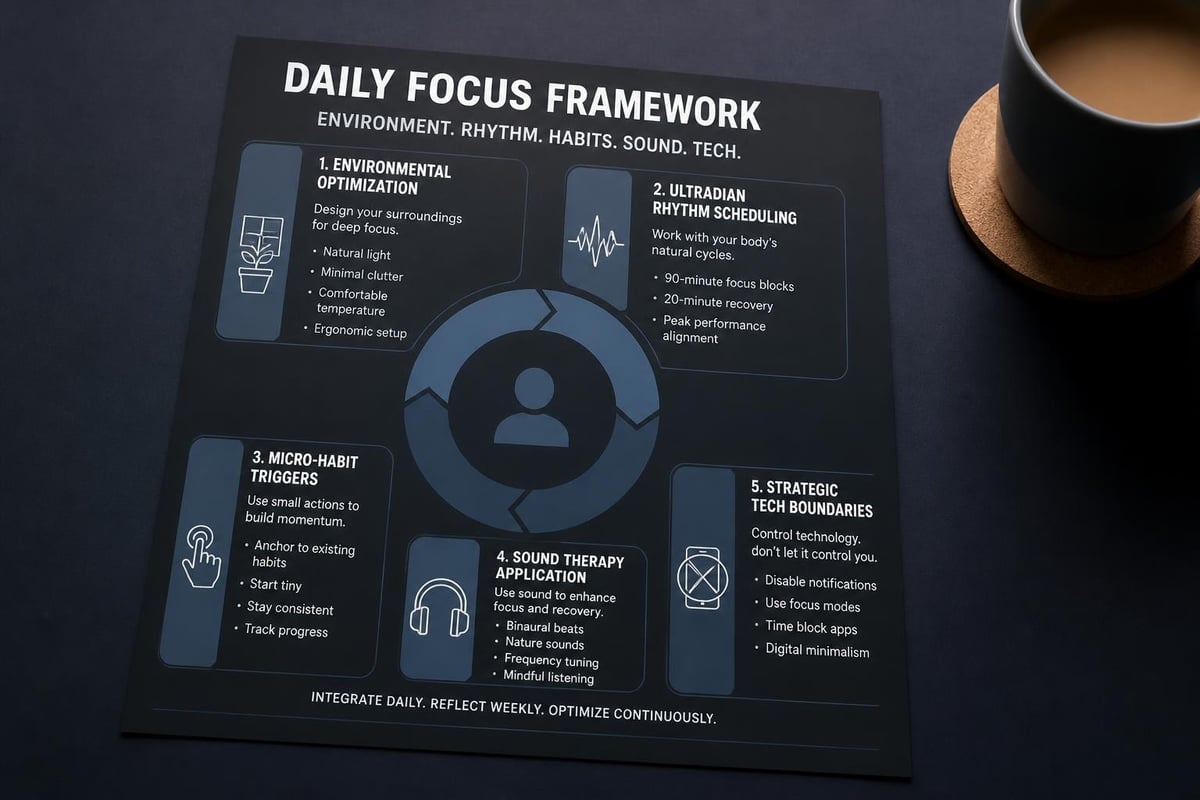
When considering how can I focus better, start by examining your environmental and biological foundations. Small adjustments to your workspace, schedule, and sensory inputs create compounding effects on attention capacity.
Optimize Your Physical Environment
Your workspace directly influences cognitive performance. Temperature, lighting, and air quality all affect mental clarity, with studies showing that temperatures between 68-72°F optimize concentration. Position your desk near natural light sources when possible, as blue-spectrum light during morning hours helps regulate circadian rhythms that govern alertness patterns.
Minimize visual clutter within your immediate field of view. Every visible object represents a potential attention draw, creating subtle cognitive load even when you're not consciously noticing these items. A clean, organized workspace reduces this background noise.
| Environmental Factor | Optimal Range | Impact on Focus |
|---|---|---|
| Temperature | 68-72°F | Cognitive processing speed |
| Lighting | 300-500 lux | Alertness, circadian alignment |
| Noise Level | 50-70 dB ambient | Concentration depth |
| Air Quality | CO2 below 1000 ppm | Decision-making clarity |
Structure Time Around Ultradian Rhythms
Your body operates on 90-minute ultradian cycles throughout the day. Energy and attention naturally peak and valley in these intervals, regardless of external demands. Working with these rhythms rather than against them dramatically improves sustainable focus. Schedule demanding cognitive work during your biological peak hours-typically 2-4 hours after waking for most people.
The Pomodoro technique and similar time-blocking methods align well with these natural cycles when customized to your personal rhythms. Rather than rigid 25-minute intervals, experiment with 50-90 minute focus blocks followed by genuine recovery periods.
Training Your Attention Through Deliberate Practice
How can I focus better over the long term? The answer lies in treating attention as a muscle requiring progressive challenge. Mindfulness practices, working memory exercises, and sustained attention drills all contribute to measurable improvements in concentration capacity.
Implement Micro-Habits for Cognitive Control
Small behavioral interventions compound into significant attention improvements. Starting each work session with a two-minute attention-setting practice-explicitly identifying your primary objective and anticipated obstacles-reduces mind-wandering by up to 40%. This simple ritual activates your prefrontal cortex's supervisory functions.
Between tasks, practice brief "cognitive resets" rather than immediately switching contexts. Research on improving concentration shows that even 60 seconds of intentional breathing or gaze-focusing helps clear mental residue from previous activities.
Key micro-habits for daily implementation:
- Morning intention setting: Define your primary focus objective before checking messages
- Pre-task breathing: Three conscious breaths before beginning focused work
- Hourly environment scans: Brief awareness of posture, tension, and mental state
- Transition rituals: Clear separation between different work modes
- Evening reflection: Five-minute review of focus quality and pattern recognition
Leverage Sound Therapy for Attention Support
Acoustic environments do more than mask distractions-they can actively support cognitive states. Binaural beats, isochronic tones, and carefully structured ambient soundscapes influence brainwave patterns measurable on EEG. When you're exploring how can I focus better, sound therapy offers a science-backed tool for state management.
The effectiveness depends on matching sound characteristics to task demands. Detail-oriented analytical work benefits from different acoustic properties than creative ideation or learning new information. Research collaborations between cognitive scientists and acoustic engineers have identified specific frequency patterns that support sustained attention without inducing drowsiness.

Biological Foundations of Sustained Focus
Physical health directly determines cognitive capacity. You cannot optimize focus through techniques alone while neglecting foundational biological needs. Maintaining healthy lifestyle habits creates the metabolic conditions necessary for peak mental performance.
Sleep Architecture and Attention Quality
Sleep deprivation devastates attention capacity more profoundly than most professionals recognize. A single night of reduced sleep (less than 7 hours) impairs focus equivalent to mild intoxication. Chronic partial sleep restriction accumulates cognitive deficits that persist even after recovery sleep.
Prioritize sleep consistency-going to bed and waking at similar times daily-over total duration when initially addressing focus challenges. Your brain's glymphatic system clears metabolic waste during specific sleep stages, with disrupted architecture preventing this essential maintenance regardless of time spent in bed.
Nutritional Strategies for Cognitive Performance
Blood glucose stability profoundly affects attention capacity. Sharp spikes and crashes in blood sugar trigger corresponding fluctuations in mental clarity. Complex carbohydrates, adequate protein, and healthy fats create sustained energy availability for your brain's high metabolic demands.
Hydration status impacts cognition more quickly than many realize. Even 2% dehydration measurably reduces working memory and attention. Keep water consistently available and drink before experiencing thirst, which signals existing deficit.
| Nutritional Factor | Impact on Focus | Practical Implementation |
|---|---|---|
| Blood glucose stability | Working memory capacity | Balanced meals every 3-4 hours |
| Omega-3 fatty acids | Processing speed | Fatty fish 2-3x weekly |
| Hydration | Reaction time, clarity | 0.5 oz per pound body weight |
| B vitamins | Energy metabolism | Whole grains, leafy greens |
| Magnesium | Stress response | Nuts, seeds, dark chocolate |
Exercise and Cognitive Enhancement
Physical activity doesn't just improve general health-it specifically enhances attention capacity through multiple mechanisms. Aerobic exercise increases hippocampal volume, improves executive function, and stimulates neuroplasticity. Regular movement supports concentration both acutely (during and immediately after exercise) and cumulatively over time.
You don't need intense training to capture these benefits. Moderate-intensity movement for 30 minutes daily produces measurable cognitive improvements. Even brief movement breaks during sedentary work-just two minutes of walking or dynamic stretching-restore attention depleted by sustained sitting.
Managing Digital Distractions Strategically
When addressing how can I focus better in 2026, digital environment design deserves special attention. Notification systems, infinite scroll mechanisms, and variable reward schedules in modern applications exploit psychological vulnerabilities that undermine concentration.
Create Intentional Technology Boundaries
Device management requires deliberate systems, not just willpower. Implement app-level controls that enforce focus periods automatically. During deep work blocks, route all communications to designated catch-up windows. This isn't about disconnecting entirely but about controlling when interruptions occur.
Consider these evidence-based digital boundaries:
- Notification batching: Receive messages only at scheduled intervals
- Grayscale mode: Reduce visual stimulation during focus periods
- App time limits: Enforce maximum daily usage for distracting platforms
- Physical separation: Keep phones in different rooms during deep work
- Browser extensions: Block distracting websites during designated hours
Design Your Information Diet
Not all digital content affects focus equally. Mindfulness practices extend beyond meditation to include conscious choices about information consumption. Passive scrolling trains your brain for distraction, while purposeful reading strengthens sustained attention.
Audit your information sources quarterly. Which feeds, subscriptions, and follows support your attention goals? Which trigger reactive browsing patterns? Curate ruthlessly toward content that aligns with your cognitive objectives.
Advanced Techniques for Deep Concentration
Beyond foundational strategies, specific protocols accelerate focus development for those asking how can I focus better at advanced levels. These methods require initial effort but produce disproportionate returns.
Attention Restoration Through Nature Exposure
Natural environments restore depleted attention through a phenomenon called "soft fascination." Unlike the directed attention required for focused work, nature engages involuntary attention gently, allowing executive function systems to recover. Even brief exposure-10 minutes viewing natural scenes-measurably improves subsequent focus.
Incorporate nature exposure strategically during your workday. Position your workspace near windows with vegetation views. Take walking meetings outdoors when possible. During breaks, prioritize natural settings over indoor environments or screens.
Working Memory Training Protocols
Your working memory capacity directly limits how much information you can actively manipulate during focused work. Dual n-back training, memory span exercises, and updating tasks specifically target this cognitive bottleneck. Research shows that consistent working memory training transfers to improved attention control across domains.
Dedicate 15-20 minutes daily to structured working memory exercises. Progress gradually, increasing difficulty as performance improves. The cognitive benefits extend beyond the training itself to general attention capacity.
Building Sustainable Focus Habits
Short-term focus techniques help during crises, but sustainable cognitive performance requires habit architecture. How can I focus better consistently over months and years? The answer involves systematic habit formation anchored to existing routines.
Stack Focus Rituals on Existing Behaviors
Habit stacking-attaching new behaviors to established routines-dramatically increases adherence. Link your attention-setting practice to your morning coffee ritual. Connect transition breathing to your existing between-meeting patterns. The established behavior triggers the new focus habit automatically.
Track your focus quality daily using simple metrics. Rate concentration on a 1-10 scale after each work block. Note environmental factors, energy levels, and technique effectiveness. Research on maintaining focus shows that self-monitoring itself improves performance through heightened awareness.
Iterate Based on Personal Patterns
Generic advice provides starting points, but optimal focus strategies are highly individual. Your chronotype, sensory preferences, and cognitive strengths differ from population averages. Experiment systematically with different techniques, tracking results to identify what specifically helps you focus better.
Common variables worth testing:
- Optimal focus block duration: 25, 50, or 90 minutes
- Break activities: Movement, meditation, or nature viewing
- Acoustic preferences: Silence, ambient sounds, or structured soundscapes
- Time of day: Morning, afternoon, or evening for demanding work
- Workspace variation: Fixed location versus environmental diversity
| Focus Strategy | Implementation Effort | Effectiveness Timeline | Sustainability |
|---|---|---|---|
| Environment optimization | Low | Immediate | High |
| Ultradian scheduling | Medium | 1-2 weeks | High |
| Sound therapy | Low | Immediate | High |
| Working memory training | High | 4-8 weeks | Medium |
| Digital boundaries | Medium | 3-7 days | High |
| Nature exposure | Low | Immediate | High |
Integrating Multiple Approaches
No single technique answers how can I focus better completely. Effective attention management combines environmental design, biological optimization, cognitive training, and behavioral systems into a coherent approach tailored to your specific challenges and goals.
Start with foundational elements-sleep, environment, and digital boundaries-before adding advanced techniques. Each layer builds on previous improvements, creating compound effects that exceed the sum of individual interventions. Focus development resembles strength training more than quick fixes: consistent progressive challenge yields lasting adaptation.
Monitor your progress across multiple dimensions rather than single metrics. Track not just productivity output but subjective focus quality, recovery adequacy, and sustainable cognitive energy. The goal isn't maximum performance extraction but optimized long-term mental capacity.
Building better focus requires understanding your brain's attention systems and implementing science-backed strategies that support sustainable concentration. By combining environmental optimization, biological foundations, cognitive training, and strategic habit formation, you create lasting improvements in mental clarity and performance. Freshhh.app brings these evidence-based approaches together in one platform, offering structured micro-habits alongside acoustic environments developed with researchers to support deeper focus and reduced mental stress. Start training your attention systematically today and experience the compounding benefits of enhanced cognitive control.