
The right auditory environment can make the difference between scattered attention and sustained mental clarity. Whether you're tackling complex projects, studying for important exams, or navigating the distractions of a busy workspace, understanding how to leverage music for concentration strategically transforms your cognitive performance. This isn't about simply pressing play on any playlist; it's about harnessing specific acoustic properties and psychological principles that align with how your brain processes information and maintains focus.
The Science Behind Music and Cognitive Performance
Research demonstrates that music influences neural pathways responsible for attention, working memory, and executive function. When you listen to carefully selected audio, your brain entrains to specific rhythmic patterns and frequencies, creating an optimal state for sustained concentration. This phenomenon occurs because auditory stimulation activates multiple brain regions simultaneously, establishing a cognitive framework that supports deeper engagement with tasks.
The relationship between sound and focus isn't universal. Individual responses vary based on personality traits, task complexity, and musical preferences. Introverts typically perform better with complete silence or minimal auditory input, while extroverts often benefit from moderate background stimulation that prevents understimulation. Understanding your cognitive profile helps you select the most effective music for concentration strategies.

Academic studies reveal that lyric-free, low-arousal instrumental music can improve attention by reducing cognitive load. When your brain processes lyrics, it diverts linguistic resources away from analytical tasks. Instrumental compositions eliminate this competition, allowing full cognitive capacity for the work at hand.
Tempo and Rhythm: The Foundation of Focus Music
The beats per minute (BPM) of your concentration music significantly impacts mental state and productivity. Optimal BPM for studying typically ranges between 60-90 beats per minute, aligning with resting heart rate and alpha brainwave frequencies associated with relaxed alertness. This tempo range creates a physiological anchor that stabilizes attention without inducing drowsiness or hypervigilance.
Music tempos outside this range serve different purposes:
- 40-60 BPM: Deep relaxation, meditation, stress reduction
- 60-90 BPM: Sustained concentration, reading, analytical work
- 90-120 BPM: Creative tasks, brainstorming, energized focus
- 120+ BPM: Physical tasks, exercise, short-burst activities
Matching tempo to task type maximizes the cognitive benefits of your auditory environment. Analytical work requiring precision benefits from slower, steadier rhythms, while creative exploration often flourishes with slightly elevated tempos that stimulate associative thinking.
Top Music Genres for Enhanced Concentration
Different musical styles offer distinct advantages for focus work. Understanding the unique properties of each genre allows you to customize your auditory environment based on specific cognitive demands and personal preferences.
Classical and Baroque Compositions
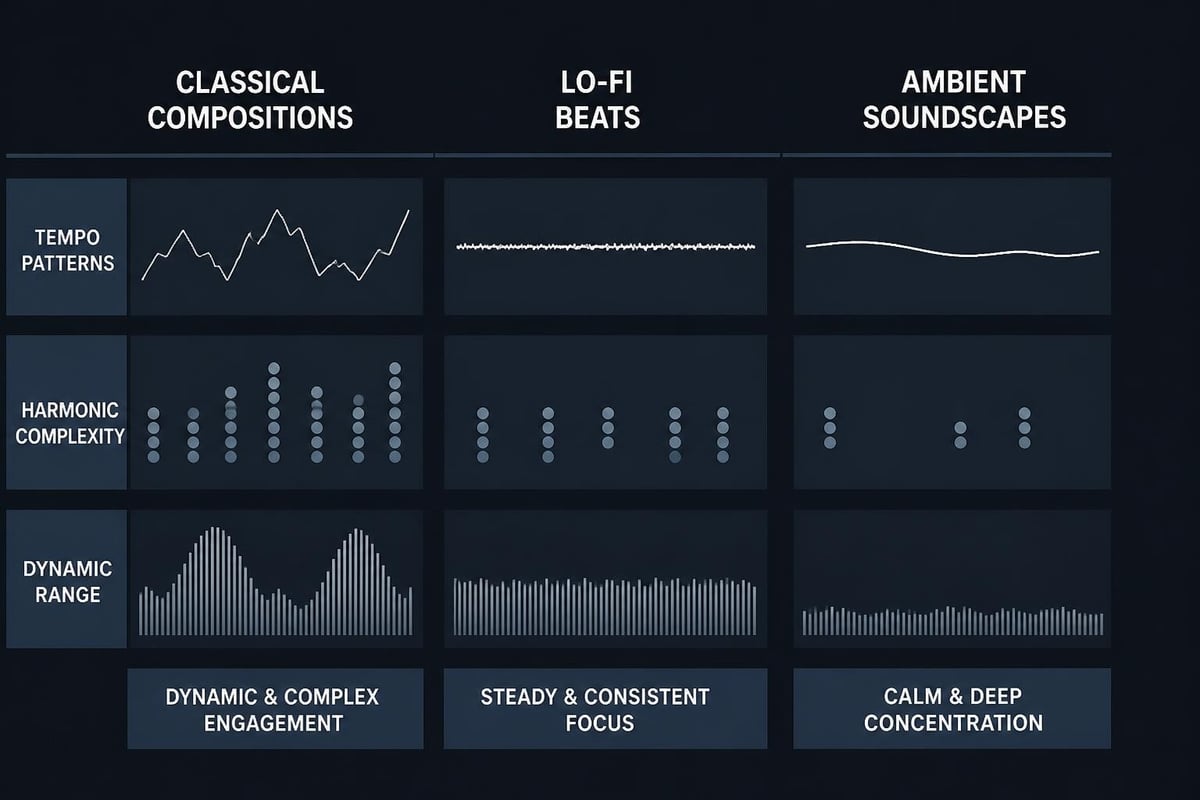
Classical music, particularly Baroque compositions from composers like Bach, Vivaldi, and Handel, consistently ranks among the most effective focus music genres based on scientific evidence. The mathematical precision and structured harmonies create predictable patterns that organize mental space without demanding active attention.
Key characteristics that support concentration:
- Predictable harmonic progressions reduce cognitive surprise
- Absence of lyrics eliminates linguistic processing demands
- Dynamic range remains moderate, avoiding jarring transitions
- Compositional complexity engages unconscious pattern recognition
The "Mozart Effect" popularized classical music for concentration, though subsequent research reveals the benefits extend beyond Mozart to encompass broader classical and instrumental traditions. The structured nature of these compositions creates an acoustic scaffold that supports sustained cognitive engagement.
Lo-Fi Hip Hop and Chillhop
Lo-fi beats have emerged as one of the most popular music genres for productivity, particularly among younger professionals and students. These tracks combine repetitive drum patterns with atmospheric samples, creating a consistent auditory texture that masks environmental distractions without becoming intrusive.
| Aspect | Classical | Lo-Fi Hip Hop | Ambient |
|---|---|---|---|
| Tempo | 60-80 BPM | 70-90 BPM | 40-70 BPM |
| Complexity | High | Moderate | Low |
| Best For | Analytical tasks | General focus | Deep work |
| Energy Level | Moderate | Moderate-high | Low-moderate |
The intentional imperfections in lo-fi production-vinyl crackle, tape hiss, slightly off-beat timing-create an authentic, lived-in quality that many find psychologically comforting. This aesthetic reduces the pressure for perfection, creating a mental space where focused work feels more accessible.
Ambient and Atmospheric Soundscapes
Ambient music prioritizes texture and atmosphere over traditional melodic or rhythmic structures. Artists like Brian Eno pioneered this approach, designing music specifically to enhance environments without demanding active listening. For music for concentration purposes, ambient compositions provide continuous acoustic presence that fills silence without creating distraction.
Ambient soundscapes work particularly well for:
- Deep focus sessions requiring minimal mental interruption
- Creative work where conventional rhythms feel restrictive
- Individuals sensitive to repetitive patterns
- Extended concentration periods exceeding two hours
Modern ambient music often incorporates natural sounds-rainfall, forest ambience, ocean waves-blended with synthesized tones. This hybrid approach connects listeners to calming environmental associations while maintaining the consistent, predictable qualities necessary for sustained focus.
Practical Strategies for Implementing Focus Music
Selecting appropriate genres represents only the first step. How you integrate music for concentration into your workflow determines its effectiveness. Strategic implementation requires attention to volume, timing, task alignment, and individual response patterns.
Volume and Acoustic Placement
Optimal volume sits between 50-70 decibels, approximately equivalent to normal conversation levels. This range provides sufficient masking of environmental noise without overwhelming auditory processing. Volume above 70 decibels triggers stress responses that counteract concentration benefits, while volume below 50 decibels fails to effectively mask distracting ambient sounds.
Consider these volume guidelines:
- Start lower than comfortable and gradually increase if distractions persist
- Adjust based on task complexity-more demanding work benefits from lower volumes
- Use headphones in shared spaces to control your acoustic environment precisely
- Monitor fatigue signals-auditory exhaustion manifests as irritability or difficulty focusing
Headphone selection matters for extended focus sessions. Over-ear designs reduce pressure fatigue compared to in-ear models, while noise-canceling technology allows lower music volumes by eliminating competing environmental sounds.
Task-Music Alignment
Different cognitive activities benefit from distinct musical approaches. Matching music characteristics to task demands optimizes concentration outcomes and prevents counterproductive auditory interference.
Analytical and detail-oriented work performs best with instrumental classical music and lo-fi chillhop featuring minimal variation and steady tempos. Creative brainstorming often benefits from slightly higher energy levels and more varied compositions that stimulate associative thinking. Administrative tasks tolerate more diverse musical selections since they require less deep cognitive engagement.
Understanding whether music helps you focus depends heavily on task type. Memorization activities generally perform better in silence or with familiar, non-distracting background music. New learning benefits from quiet or specifically designed study music that doesn't compete with information encoding processes.
Building a Rotation Strategy
Auditory habituation diminishes the effectiveness of any single playlist over time. Your brain adapts to familiar patterns, reducing the masking effect and allowing environmental distractions to penetrate awareness. Rotating between multiple playlists maintains novelty while preserving the concentration benefits of structured music.
Create three to five distinct playlists representing different energy levels and musical styles. Alternate between them based on time of day, task type, and mental state. This approach prevents habituation while providing flexibility to match your auditory environment to current needs.
Common Mistakes That Undermine Focus Music Benefits
Even when selecting appropriate genres, implementation errors reduce concentration outcomes. Recognizing these pitfalls helps you extract maximum benefit from your music for concentration strategy.
Selecting Overly Familiar or Emotionally Charged Music
Music carrying strong memories or emotional associations diverts attention toward internal narrative rather than external tasks. That song from your college years triggers reflection on past experiences, effectively creating an internal distraction equivalent to environmental noise.
Focus music should remain emotionally neutral and relatively unfamiliar. Newness engages unconscious pattern recognition without triggering autobiographical memory systems. This principle explains why many successful focus playlists feature international artists or instrumental versions of popular songs-they provide structure without personal history.
Inconsistent Implementation
Sporadic use prevents your brain from developing associations between specific auditory environments and focused mental states. Consistent pairing of music with concentration work creates a conditioned response where beginning your focus playlist triggers the cognitive shift toward deeper engagement.
Establish ritual around your music for concentration practice:
- Begin each focus session with the same opening track
- Use consistent volume settings across sessions
- Pair music with other focus triggers like specific seating or lighting
- Maintain regular session timing to reinforce neural patterns
Ignoring Individual Response Patterns
Generic advice fails to account for neurodiversity and individual cognitive profiles. What works for neurotypical individuals may prove counterproductive for those with ADHD, autism spectrum traits, or sensory processing differences. Music’s impact on focus varies substantially across the population.
Monitor your personal response through simple tracking:
| Session Date | Music Type | Task Type | Perceived Focus (1-10) | Completion Rate |
|---|---|---|---|---|
| Example data | Lo-fi beats | Writing | 8 | 90% |
| Example data | Classical | Analysis | 7 | 85% |
| Example data | Ambient | Creative | 9 | 95% |
This data reveals patterns specific to your cognitive profile, allowing evidence-based refinement of your concentration music strategy.

Advanced Approaches: Beyond Passive Listening
Music for concentration extends beyond simple background audio. Advanced techniques integrate auditory stimulation with cognitive training, creating comprehensive approaches that address both environmental factors and mental discipline.
Binaural Beats and Frequency-Based Approaches
Binaural beats present slightly different frequencies to each ear, creating a perceived third frequency equal to the difference between the two tones. When the difference falls within specific ranges, the brain allegedly entrains to that frequency, potentially inducing desired mental states.
Research on binaural beats remains mixed, with some studies showing modest improvements in focus and others finding negligible effects. Individual responses vary significantly, making personal experimentation the most reliable assessment method. If exploring binaural beats, begin with alpha frequency ranges (8-12 Hz) associated with relaxed alertness.
Combining Music with Micro-Habits and Mental Training
The most effective concentration strategies integrate auditory support with active cognitive training. Rather than relying solely on music to create focus, pair it with deliberate attention-building practices that strengthen underlying mental capabilities.
Effective combinations include:
- Pomodoro Technique: Use distinct music for work intervals versus break periods, creating clear acoustic boundaries between focused and rest states
- Attention anchoring: Begin each track by deliberately noting your intention and returning attention to breath before engaging tasks
- Progressive session building: Start with shorter focus periods accompanied by music, gradually extending duration as concentration capacity increases
- Mindful transitions: Use the first 30 seconds of each new track to scan for and release physical tension
This integrated approach treats music as one component within a broader concentration ecosystem rather than a standalone solution. The combination of acoustic environment management and active mental training produces results exceeding either approach alone.
Personalizing Your Acoustic Environment
While genre recommendations provide useful starting points, optimal music for concentration ultimately depends on individual response patterns, task requirements, and environmental contexts. Developing a personalized system requires experimentation, observation, and iterative refinement.
Start with scientifically supported genres like classical and lo-fi beats for memory and focus, then systematically test variations. Note which specific artists, albums, or compositional characteristics produce the strongest concentration outcomes for different task types. This empirical approach builds a customized acoustic toolkit aligned with your unique cognitive profile.
Consider environmental factors beyond the music itself. Room acoustics, competing sounds, time of day, and physiological state all influence how effectively music supports concentration. A holistic perspective accounts for these variables, treating auditory environment as one element within the broader context of focus optimization.
Creating Sustainable Focus Music Practices
Long-term success with music for concentration requires sustainable approaches that adapt to changing needs and prevent dependency on external auditory stimulation. Balance between leveraging acoustic support and developing intrinsic focus capabilities creates resilience across diverse working conditions.
Developing Acoustic Flexibility
Train your concentration capacity across multiple auditory conditions rather than becoming dependent on specific music or complete silence. Practice focus work in silence, with nature sounds, with various music genres, and in moderately noisy environments. This flexibility ensures productivity remains accessible regardless of acoustic circumstances.
Progressive exposure schedule:
- Week 1-2: Establish baseline with preferred music for concentration approach
- Week 3-4: Alternate sessions between music and silence
- Week 5-6: Practice focus in controlled noise (café sounds, office ambience)
- Week 7-8: Rotate randomly between all conditions
This training develops acoustic adaptability while maintaining the option to leverage music strategically when it provides greatest benefit.
Integrating Music with Broader Wellness
Concentration capacity extends beyond auditory environment to encompass sleep quality, stress management, physical health, and mental resilience. Music genres and sound therapy support these foundational elements, creating comprehensive approaches that address root causes of distraction rather than merely masking symptoms.
Consider music for concentration as one component within an integrated wellness system that includes adequate sleep, regular movement, stress reduction practices, and cognitive training. This holistic perspective prevents over-reliance on any single technique while building robust, multi-faceted focus capabilities.
Strategic use of music for concentration offers powerful support for sustained mental clarity and cognitive performance, particularly when you understand the science behind tempo, genre selection, and individual response patterns. The most effective approaches combine scientifically-backed auditory environments with active cognitive training and attention to broader wellness factors. If you're ready to move beyond simple background playlists toward a comprehensive focus training system, Freshhh.app provides science-backed soundscapes developed with acoustic researchers alongside practical micro-habits and research-based techniques that strengthen your intrinsic concentration capabilities. Start building your personalized focus practice today with tools designed to train your mind, not just fill the silence.