Sound healing tuning forks have emerged as powerful tools in the wellness landscape, bridging ancient healing wisdom with modern acoustic science. These precisely calibrated instruments produce pure tones that interact with the body's natural frequencies, offering a non-invasive approach to enhancing mental clarity, reducing stress, and supporting overall well-being. As more people seek evidence-based methods to improve focus and calm their minds, understanding how these specialized forks work and their practical applications becomes increasingly valuable for anyone committed to optimizing their mental performance and emotional balance.
The Science Behind Tuning Fork Therapy
Sound healing tuning forks operate on fundamental principles of physics and human physiology. When struck, these metal instruments vibrate at specific frequencies, measured in Hertz (Hz), creating acoustic waves that travel through air and physical contact. The human body, composed of approximately 70% water, serves as an excellent conductor for these vibrational frequencies.
Research indicates that tuning forks interact with the body’s fascia, the connective tissue network throughout our systems. This interaction creates a phenomenon called entrainment, where biological rhythms synchronize with external frequencies. When a tuning fork produces its characteristic tone, cells and tissues can respond by adjusting their own vibrational patterns to match or harmonize with the introduced frequency.
Frequency Resonance and Brain Wave States
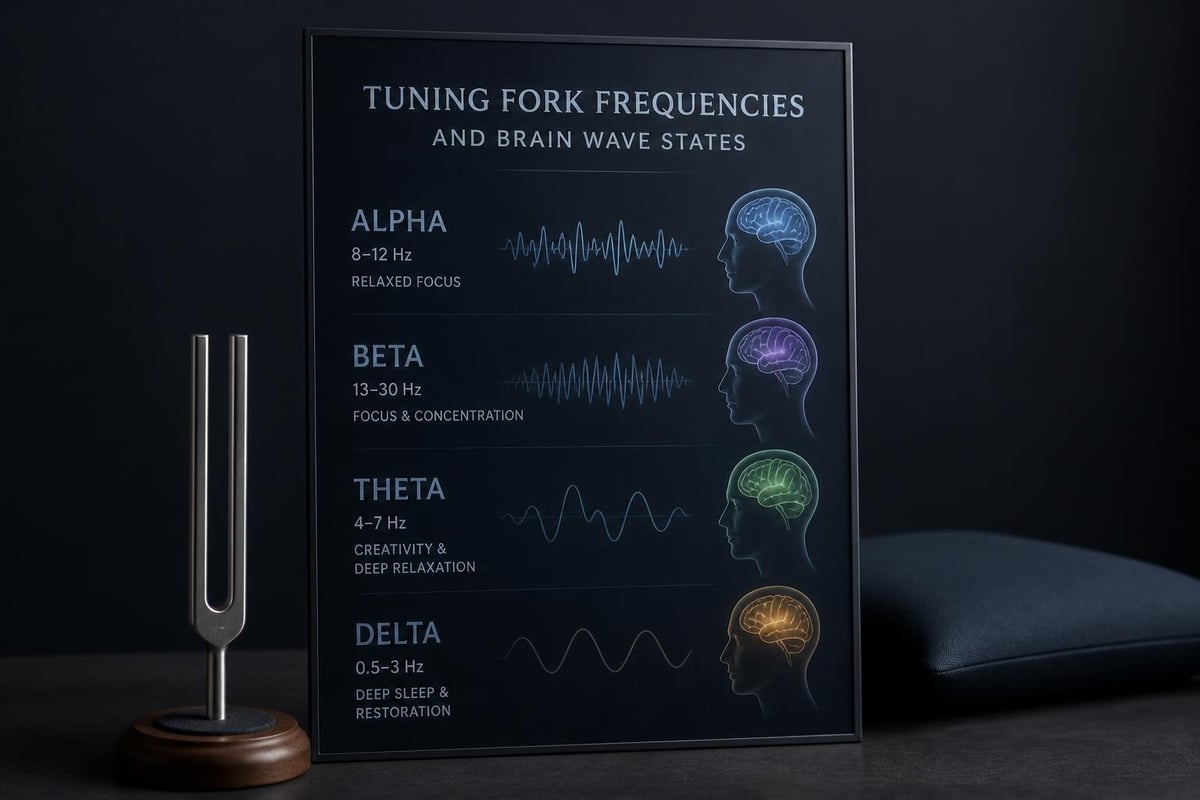
Different tuning fork frequencies correlate with specific brain wave states that influence our mental and emotional experiences:
- Alpha waves (8-13 Hz): Associated with relaxed alertness and creative thinking
- Beta waves (13-30 Hz): Linked to focused attention and active problem-solving
- Theta waves (4-8 Hz): Connected to deep meditation and enhanced learning
- Delta waves (0.5-4 Hz): Related to restorative sleep and healing processes
The mechanisms behind tuning fork therapy suggest that applying specific frequencies can encourage the brain to shift into desired states. This application supports better concentration during work sessions or facilitates relaxation after stressful experiences.
Types and Categories of Sound Healing Tuning Forks
Understanding the various types of tuning forks available helps practitioners and enthusiasts select appropriate tools for their specific wellness goals.
Weighted Versus Unweighted Forks
| Type | Weight Range | Primary Use | Application Method |
|---|---|---|---|
| Weighted | 50-250 grams | Body work, deep tissue resonance | Direct contact on body |
| Unweighted | 15-40 grams | Energy field work, auditory healing | Near or around body |
| Dual-purpose | Variable | Versatile applications | Both contact and proximity |
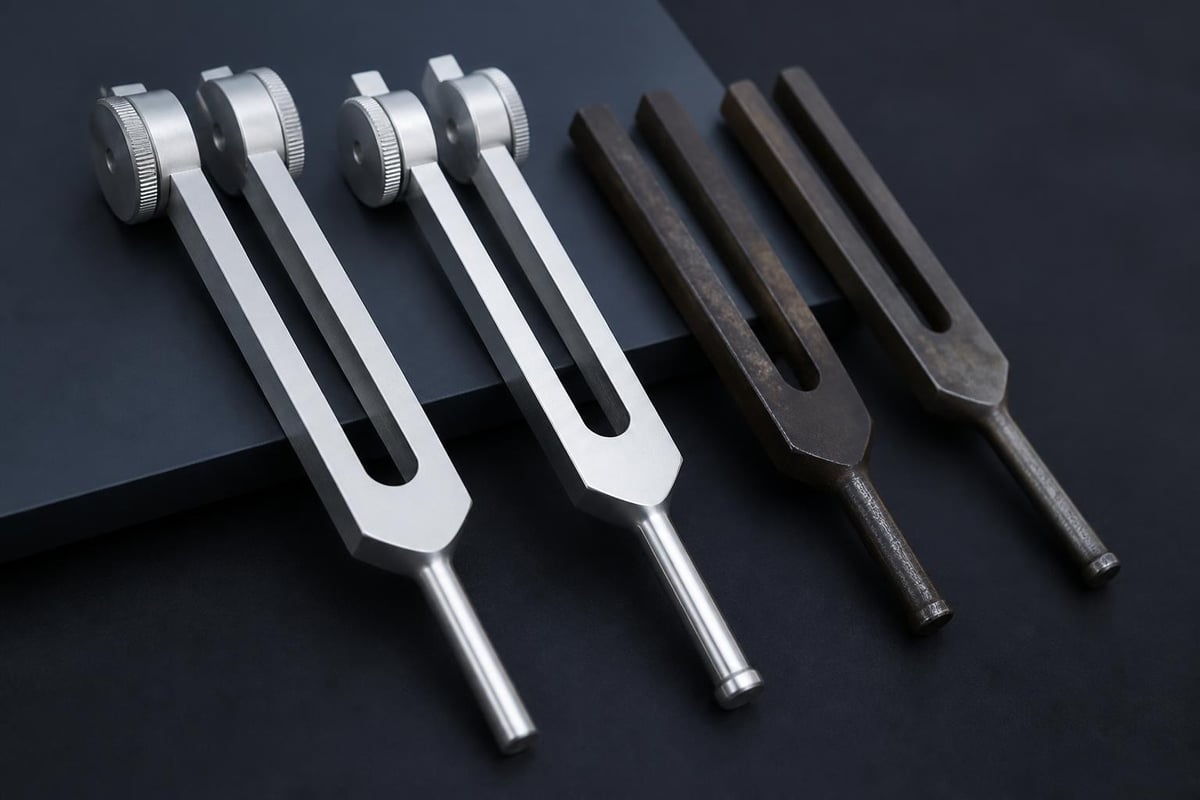
Weighted sound healing tuning forks feature rounded weights at the ends of each prong. These designs create stronger vibrations suitable for placing directly on the body, particularly over energy centers, acupressure points, or areas of tension. The physical sensation of vibration combines with the auditory frequency to create a multi-sensory healing experience.
Unweighted forks produce clearer, longer-lasting tones. Practitioners hold these near the ears or around the body's energy field without direct contact. The pure acoustic quality makes them ideal for auditory entrainment and supporting meditation practices.
Common Frequency Sets
Solfeggio Frequencies: This ancient scale includes specific tones believed to have distinct healing properties:
- 396 Hz: Liberating guilt and fear
- 417 Hz: Facilitating change and releasing negative patterns
- 528 Hz: DNA repair and transformation
- 639 Hz: Enhancing relationships and connection
- 741 Hz: Awakening intuition and problem-solving
- 852 Hz: Spiritual awareness and clarity
Planetary Frequencies: Based on calculations of planetary orbital periods, these forks correspond to celestial bodies. The 136.10 Hz "OM" frequency, derived from Earth's year, is particularly popular for grounding and centering practices.
Chakra Tuning Forks: Aligned with the seven primary energy centers, ranging from 194.18 Hz (root chakra) to 480 Hz (crown chakra), these support energetic balance throughout the body's meridian system.
Practical Applications for Focus and Mental Clarity
Sound healing tuning forks offer concrete benefits for those seeking to enhance cognitive performance and manage stress more effectively. The systematic application of specific frequencies creates measurable changes in attention span, mental stamina, and emotional regulation.
Pre-Work Activation Protocols
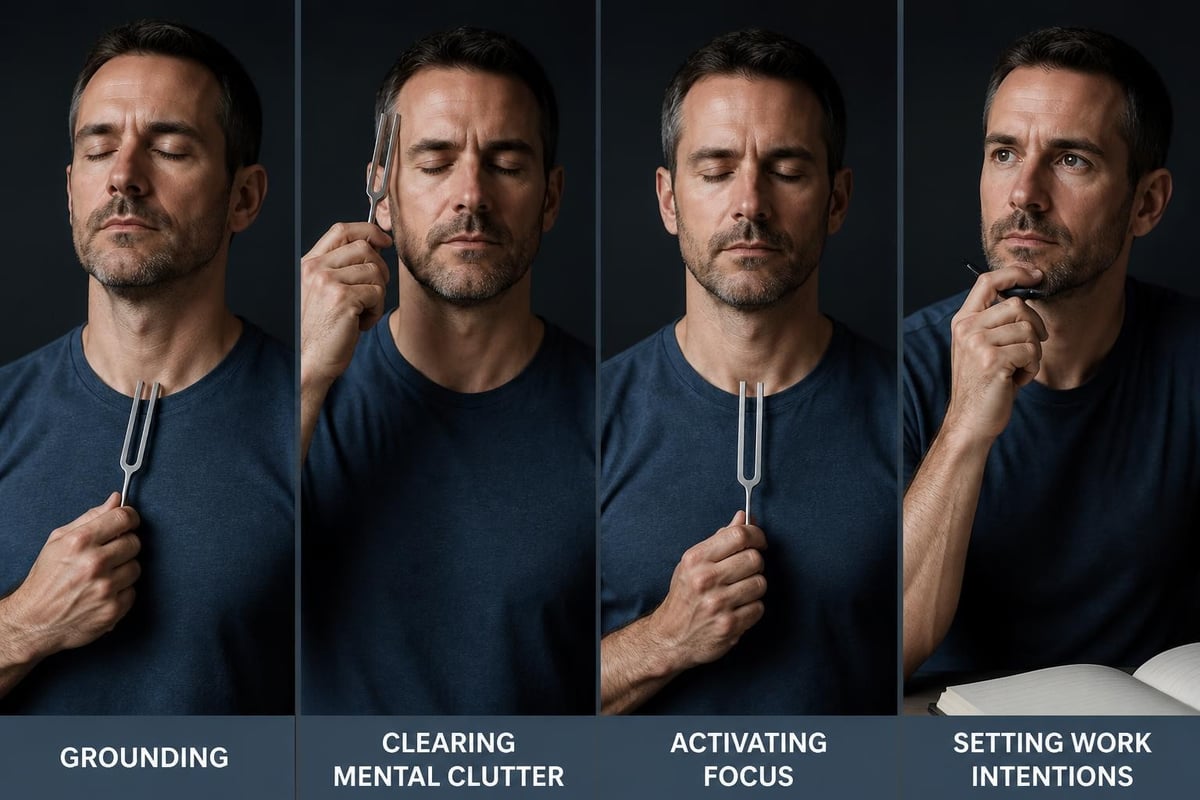
Beginning work sessions with tuning fork protocols can optimize mental readiness. A typical activation sequence involves:
- Grounding (136.10 Hz): Three minutes of the OM frequency to establish baseline calm
- Clearing (417 Hz): Two minutes to release mental clutter from previous activities
- Focus activation (Beta range forks): One minute to prime the brain for concentrated work
- Intention setting: Silent moment to clarify session objectives
This structured approach, similar to how Freshhh.app combines soundscapes with practical micro-habits, creates a ritual that signals to the nervous system that focused work is beginning.
Stress Interruption Techniques
During high-stress moments, specific tuning fork interventions can rapidly shift physiological states. The bilateral application method demonstrates particular effectiveness:
- Hold matching forks near each ear simultaneously
- Create stereo effect with complementary frequencies
- Allow 60-90 seconds for nervous system response
- Follow with three deep breaths to anchor the state shift
Research on vibrational medicine applications shows that bilateral stimulation activates both brain hemispheres, facilitating faster transitions from stressed to calm states.
Integration with Modern Wellness Practices
The most effective use of sound healing tuning forks occurs when integrated thoughtfully into comprehensive wellness routines rather than used as isolated interventions.
Combining Sound and Behavioral Techniques
Pairing tuning fork sessions with evidence-based cognitive strategies amplifies both modalities. Before important meetings or creative work, combining a 528 Hz fork session with specific mental preparation techniques creates synergistic effects. The acoustic frequency supports neurological receptivity while behavioral practices direct that enhanced state toward productive outcomes.
Consider this integrated approach:
Morning Focus Ritual (15 minutes total):
- 5 minutes: Tuning fork meditation with grounding frequencies
- 5 minutes: Priority identification and task sequencing
- 5 minutes: Visualization of successful completion
- Throughout: Intentional breathing patterns
This structure mirrors the comprehensive approach where sound serves as the foundation supporting practical mental training, much like how modern focus applications combine multiple modalities for optimal results.
Professional and Personal Use Contexts
| Context | Recommended Frequencies | Session Duration | Optimal Timing |
|---|---|---|---|
| Office focus work | 396 Hz, 417 Hz, Beta range | 3-5 minutes | Before deep work blocks |
| Creative brainstorming | 528 Hz, 639 Hz | 8-10 minutes | Mid-morning or mid-afternoon |
| Post-work decompression | 432 Hz, Alpha range | 10-15 minutes | End of workday transition |
| Pre-sleep relaxation | Theta/Delta range | 15-20 minutes | 30 minutes before bed |
Selection Criteria and Quality Considerations
Not all tuning forks deliver equal therapeutic value. Discerning practitioners recognize that quality, precision, and appropriate selection directly impact effectiveness.
Material and Manufacturing Standards
Premium sound healing tuning forks typically use aerospace-grade aluminum alloys or specialized steel formulations. These materials maintain frequency accuracy over thousands of strikes and resist temperature-induced pitch variations. High-quality instruments should include frequency certification, confirming that each fork vibrates within 0.5% of its stated Hz value.
Manufacturing precision affects tonal purity. Machine-tuned forks offer greater consistency than hand-tuned alternatives, though some practitioners prefer the subtle uniqueness of artisan-crafted pieces. The finish quality matters too because surface imperfections can create harmonic distortions or unwanted overtones.
Starting Your Collection
For newcomers exploring tuning fork therapy, strategic acquisition prevents overwhelming complexity and unnecessary expense:
- Begin with fundamental frequencies: Acquire the 136.10 Hz (OM) and 528 Hz forks first
- Add weighted and unweighted versions: Experience both application styles
- Expand based on specific goals: Select additional frequencies addressing your primary wellness objectives
- Consider activators: Rubber or wooden striking tools protect fork integrity
Budget-conscious practitioners might start with a basic three-fork set covering grounding, clearing, and activation functions before expanding into specialized frequencies.
Evidence-Based Practice and Measurable Outcomes
While sound healing tuning forks have historical roots in ancient practices, contemporary applications benefit from rigorous evaluation and outcome tracking.
Documenting Personal Response Patterns
Maintaining a simple practice log reveals individual response patterns and optimizes fork selection:
- Date and time: Track circadian influences on effectiveness
- Frequency used: Note which Hz values were applied
- Application method: Record contact versus proximity use
- Duration: Document session length
- Pre/post state: Rate focus, stress, or target metrics (1-10 scale)
- Environmental factors: Note setting, distractions, time since last break
After 2-3 weeks of consistent logging, patterns emerge showing which frequencies and protocols deliver optimal personal results. This data-driven approach aligns with how understanding tuning fork applications enhances therapeutic outcomes through personalized refinement.
Integrating with Objective Measurements
Pairing subjective experience with objective data strengthens practice effectiveness:
- Heart rate variability (HRV): Measure before and after sessions to track nervous system regulation
- Productivity metrics: Compare focus duration and output quality on days with versus without fork protocols
- Sleep quality scores: Monitor rest patterns when using evening relaxation frequencies
- Stress biomarkers: Track cortisol levels or blood pressure changes over extended practice periods
These measurements transform sound healing tuning forks from abstract wellness tools into concrete performance optimization instruments.
Advanced Techniques and Layered Applications
As practitioners develop proficiency with basic applications, advanced techniques offer deeper therapeutic potential and more nuanced state management.
Overtone Stacking Methods
Playing multiple forks simultaneously creates complex harmonic relationships that can target multiple wellness objectives:
Focus Enhancement Stack:
- Base frequency: 136.10 Hz (grounding)
- Harmonic layer: 272.20 Hz (doubled OM for mental clarity)
- Activation tone: Beta range fork (focused attention)
Strike forks in sequence, allowing each tone to establish before adding the next layer. The resulting sonic environment supports multi-dimensional mental states where calm alertness coexists with sharp concentration.
Body Mapping Protocols
Systematic application patterns across the body create comprehensive resonance effects. A complete session might include:
- Foundation (feet): Grounding frequencies to establish stability
- Core activation (solar plexus): Personal power and confidence frequencies
- Heart opening (chest): Connection and emotional balance tones
- Clarity activation (third eye): Mental acuity and insight frequencies
- Integration (crown): Whole-system coherence
Each position receives 30-60 seconds of fork application, either through direct contact with weighted forks or proximity work with unweighted instruments.
Safety Considerations and Contraindications
While sound healing tuning forks offer generally safe applications, certain situations require modification or avoidance.
When to Exercise Caution
Avoid direct body application with weighted forks:
- Over open wounds or recent surgical sites
- On areas with metal implants or pacemakers
- During first trimester of pregnancy
- Over fractured or severely inflamed areas
Modify intensity or frequency selection:
- For individuals with sound sensitivity or misophonia
- When working with trauma survivors (certain frequencies may trigger responses)
- In cases of severe mental health conditions without professional guidance
- For children under 12 (use gentler frequencies and shorter sessions)
Unweighted forks used in proximity rather than contact offer safer alternatives for most contraindicated situations, though consultation with healthcare providers remains advisable.
Hygiene and Maintenance Standards
Proper fork care ensures longevity and prevents cross-contamination in professional settings:
- Clean with 70% isopropyl alcohol after each use
- Store in protective cases away from extreme temperatures
- Avoid dropping, which can alter calibration
- Re-certify frequency accuracy annually for professional use
- Replace forks showing visible damage or pitch drift
Training Your Mind Through Consistent Practice
The true power of sound healing tuning forks emerges through consistent, intentional practice rather than sporadic application. This principle aligns with broader understanding that sustainable wellness requires training mental patterns, not merely applying external interventions.
Building a Sustainable Routine
Week 1-2: Establish baseline familiarity
- Single 5-minute morning session with one frequency
- Focus on observing sensations without judgment
- Simple activation before one daily task
Week 3-4: Introduce variability
- Add second frequency for different contexts
- Experiment with weighted versus unweighted application
- Begin tracking subjective responses
Week 5-8: Refine and personalize
- Develop signature protocols for common situations
- Integrate with existing wellness practices
- Measure outcomes against baseline metrics
This progressive approach prevents overwhelming complexity while building genuine competency. The healing properties and applications become more accessible through graduated exposure rather than attempting comprehensive mastery immediately.
Pairing Sound with Mental Micro-Habits
Sound healing tuning forks achieve maximum impact when paired with complementary cognitive practices:
- Breath synchronization: Match inhalation/exhalation to fork tone cycles
- Intention anchoring: Set specific mental objectives before each session
- Gratitude integration: Combine frequencies with appreciation practices
- Transition rituals: Use consistent fork protocols to mark context switches
- Recovery intervals: Apply relaxation frequencies during work breaks
These combinations create multi-layered interventions where sound establishes neurological readiness while behavioral techniques direct that optimized state toward concrete goals.
Sound healing tuning forks represent a practical intersection of ancient wisdom and modern acoustic science, offering tangible tools for enhancing focus, managing stress, and cultivating mental clarity through precise vibrational frequencies. When integrated with evidence-based cognitive strategies and consistent practice routines, these instruments become powerful allies in the ongoing work of training your mind for peak performance. Freshhh.app extends this philosophy by combining research-backed soundscapes with actionable micro-habits, creating a comprehensive system for developing lasting focus and calm that goes beyond passive listening to active mental training. Whether you're exploring tuning forks independently or seeking a complete digital companion for your wellness journey, the key lies in consistent practice and intelligent integration of multiple modalities working in harmony.