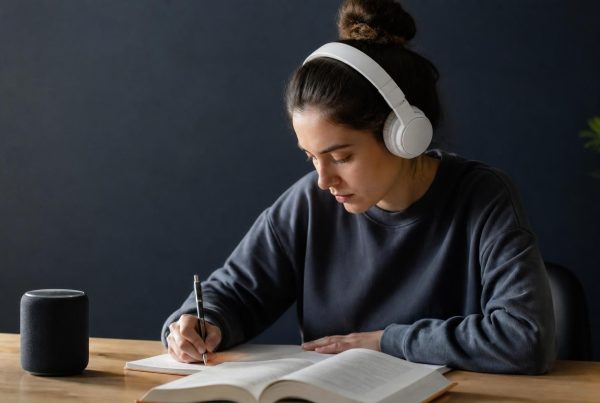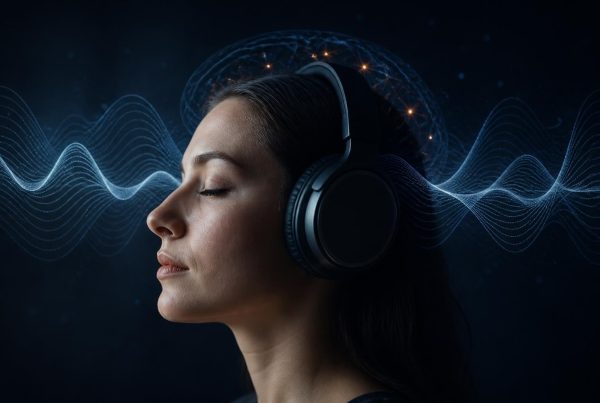
The modern workplace presents unprecedented challenges to maintaining focus. Between open office layouts, constant notifications, and the cognitive demands of complex tasks, our attention spans face relentless assault. White noise for focus has emerged as a scientifically validated tool for combating these distractions, offering a simple yet powerful solution for professionals seeking deeper concentration. Unlike traditional background music or silence, white noise creates a consistent acoustic blanket that helps your brain filter out unpredictable interruptions while maintaining the mental clarity needed for sustained productivity.
Understanding White Noise and Its Impact on Cognitive Performance
White noise represents equal energy distribution across all audible frequencies, creating a steady, uniform sound similar to static or a rushing waterfall. This consistent acoustic signal plays a unique role in how our brains process environmental information.
The Science Behind Sound Masking
Our auditory system evolved to detect changes in our environment, making us naturally sensitive to sudden noises. Research has shown that white noise can enhance certain cognitive functions by creating a stable acoustic backdrop that reduces the brain's need to monitor for environmental threats. This phenomenon, called stochastic resonance, suggests that adding controlled noise can actually improve signal detection in neural systems.
The mechanism works through several pathways:
- Masking irregular sounds: White noise covers unpredictable environmental noises that trigger involuntary attention shifts
- Reducing auditory contrast: By filling quiet periods with consistent sound, white noise minimizes the contrast between silence and sudden interruptions
- Stabilizing neural activity: Continuous auditory input helps maintain steady baseline activity in attention networks
- Supporting working memory: Reduced distraction processing frees cognitive resources for task-relevant information

Individual Variation in Response to White Noise
Not everyone experiences white noise for focus benefits equally. Individual differences in baseline arousal, attention capacity, and even personality traits influence how effectively white noise supports concentration.
Studies examining white noise effects on attention in individuals with ADHD reveal particularly interesting patterns. For some people with attention difficulties, moderate levels of background noise actually improve performance compared to silence. This suggests that optimal arousal levels vary considerably across individuals.
| Individual Factor | Response to White Noise | Optimization Strategy |
|---|---|---|
| High baseline arousal | May find it overstimulating | Lower volume, shorter sessions |
| Low baseline arousal | Often shows improvement | Moderate volume, sustained use |
| ADHD characteristics | Variable but often positive | Experimentation with intensity |
| High sensitivity to sound | Mixed results | Gradual introduction, personalization |
Implementing White Noise Effectively in Your Workflow
Strategic implementation determines whether white noise for focus becomes a productivity asset or merely another form of background noise. The difference lies in thoughtful application rather than passive listening.
Volume Calibration and Timing
Volume represents the most critical variable in white noise effectiveness. Too quiet, and it fails to mask distractions. Too loud, and it becomes a distraction itself. Research suggests optimal levels typically fall between 45-55 decibels, roughly equivalent to moderate rainfall or a quiet conversation in an adjacent room.
Consider these implementation guidelines:
- Start below your comfort level: Begin with white noise barely audible and gradually increase until you notice distraction reduction
- Match volume to environment: Louder settings suit noisier environments, while quieter levels work in already-controlled spaces
- Time your sessions: Use white noise during deep work blocks rather than continuously throughout the day
- Allow adaptation periods: Your brain needs 15-20 minutes to fully adjust to the acoustic environment
Comparing White Noise to Other Sound Colors
While white noise contains all frequencies equally, different noise colors affect focus and concentration differently. Pink noise emphasizes lower frequencies, creating a softer, more natural sound. Brown noise concentrates even more energy in bass ranges, producing a deeper, rumbling quality.
Each variety serves different preferences and situations:
- White noise: Best for high-distraction environments requiring strong masking
- Pink noise: Ideal for sustained focus work with less harsh qualities
- Brown noise: Suited for deep concentration requiring maximum environmental isolation
The choice between these options depends on personal preference, task requirements, and environmental characteristics. Many users find that white noise for focus works best during analytical tasks requiring sharp attention, while warmer noise colors support creative work.
White Noise Applications Across Different Work Contexts
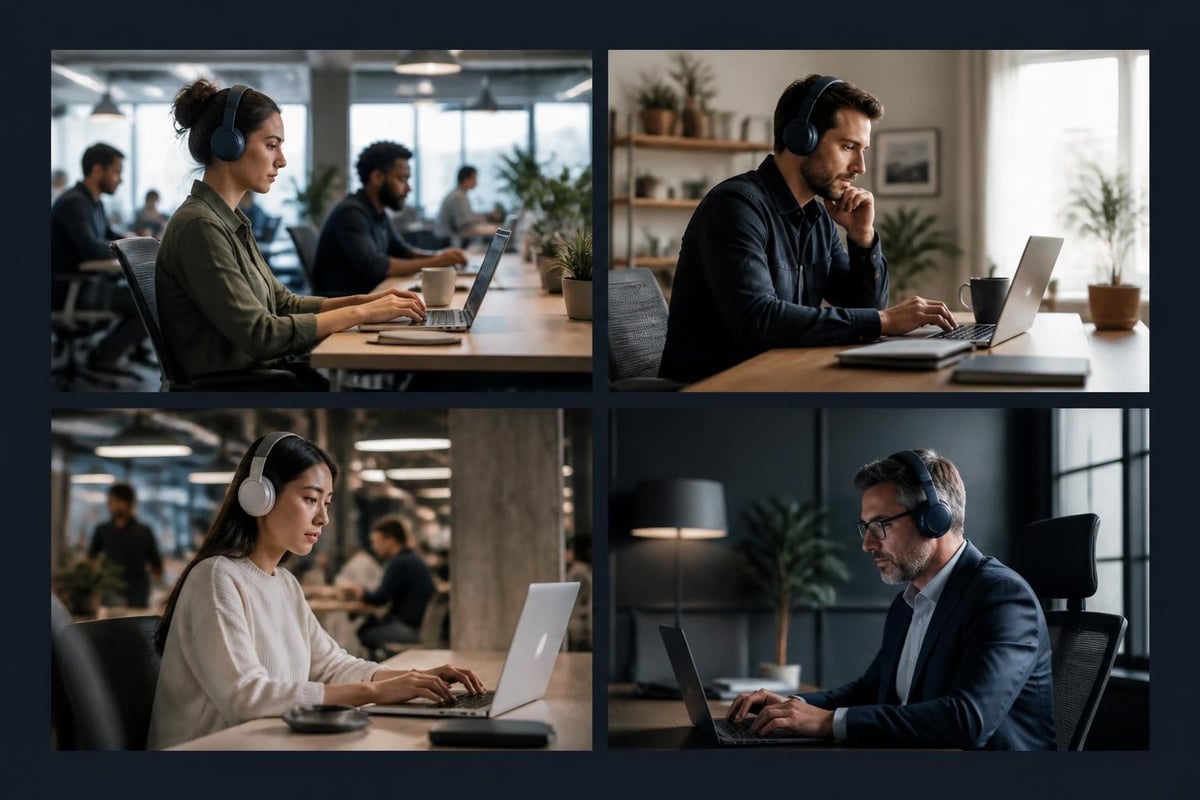
Modern work environments span from bustling open offices to quiet home setups, each presenting unique acoustic challenges. Understanding how white noise for focus adapts to various contexts helps maximize its benefits.
Open Office and Shared Workspace Solutions
Most workers report that returning to open offices reduces productivity, with acoustic distractions ranking among the top complaints. White noise offers a personal acoustic boundary without requiring physical modifications to the environment.
Deployment strategies for shared spaces:
In open offices, personal white noise through headphones creates individual focus zones without disturbing colleagues. This approach provides several advantages over ambient office sound systems, including personalized volume control and immediate availability.
Quality headphones matter significantly in these environments. Over-ear designs with passive noise isolation work synergistically with white noise, combining physical sound blocking with acoustic masking for maximum distraction reduction.
Remote Work and Home Office Integration
Home environments present different challenges, including household noises, neighbor activities, and the psychological difficulty of separating work from personal space. White noise for focus helps establish acoustic boundaries that signal work mode to both your brain and household members.
| Home Distraction Type | White Noise Effectiveness | Complementary Strategies |
|---|---|---|
| Intermittent loud noises | High | Higher volume settings, over-ear headphones |
| Constant low-level sounds | Moderate | Lower volume, combined with door closure |
| Unpredictable interruptions | High | Visual cues (closed door, headphones visible) |
| Internal distractions | Variable | Structured work blocks, habit stacking |
Building Sustainable Focus Habits with White Noise
Relying solely on white noise for focus without addressing underlying attention patterns misses opportunities for lasting cognitive improvement. The most effective approach integrates white noise into broader focus-building practices.
Pairing White Noise with Micro-Habits
Micro-habits are small, consistent behaviors that compound over time to create substantial change. When combined with white noise, these practices reinforce focus capacity:
- The Two-Minute Start: Begin work sessions with two minutes of white noise before opening task materials, training your brain to associate the sound with concentration
- Transition Rituals: Use white noise as an acoustic boundary marker, turning it on when starting focused work and off during breaks
- Attention Check-Ins: Set subtle periodic reminders to assess focus quality while white noise plays
- Progressive Sessions: Gradually extend white noise-supported focus periods, building concentration stamina
Evidence-Based Volume and Duration Guidelines
Research on optimal white noise for studying emphasizes that both volume and duration significantly impact effectiveness. Excessive exposure can lead to adaptation, where the brain begins treating white noise as background and stops using it for distraction masking.
Recommended implementation patterns:
Sessions of 25-90 minutes align with natural attention cycles and prevent acoustic fatigue. The Pomodoro Technique's 25-minute work blocks pair particularly well with white noise, creating clear acoustic boundaries between focus and rest periods.
Between sessions, silence or very different acoustic environments help reset your auditory system. This contrast prevents habituation and maintains white noise effectiveness across multiple daily focus periods.
Measuring and Optimizing Your White Noise Practice
Subjective feelings about productivity don't always align with actual performance improvements. Systematic tracking reveals which white noise for focus approaches deliver genuine benefits versus placebo effects.
Performance Metrics Worth Tracking
Quantitative measures:
- Task completion rate during white noise sessions versus silence
- Error frequency in detail-oriented work
- Time to reach flow state
- Number of distraction incidents per hour
Qualitative assessments:
- Perceived mental clarity
- End-of-session mental fatigue
- Ease of returning to tasks after interruptions
- Overall satisfaction with work output
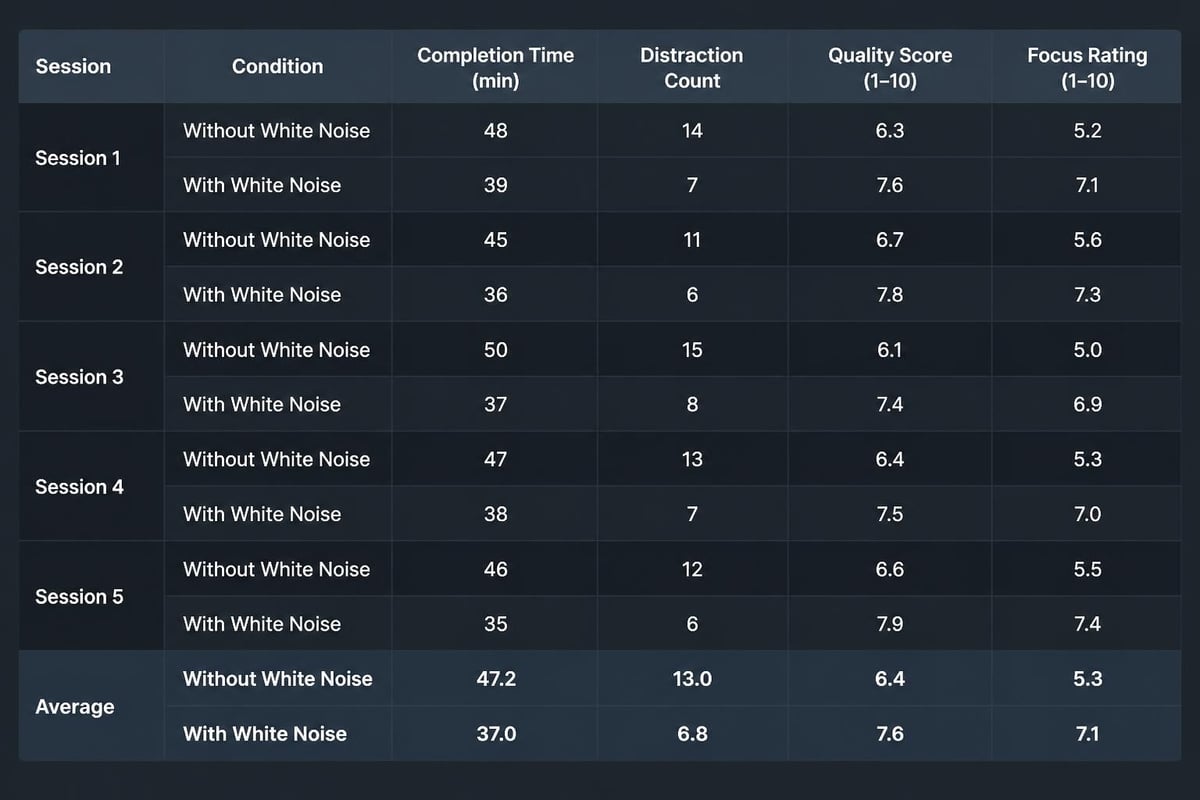
Studies examining white noise effects on sustained attention and response time demonstrate measurable improvements in consistency rather than just speed. This suggests that white noise's primary benefit lies in reducing performance variability, helping you maintain steady output throughout work sessions.
Experimentation Framework
Scientific optimization requires controlled experimentation. Structure your white noise testing using these principles:
Week 1-2: Baseline measurement
Document typical focus performance without white noise intervention. Track the same metrics you'll use during white noise trials.
Week 3-4: Initial white noise introduction
Implement white noise at moderate volume during half your focus sessions. Compare performance between white noise and baseline conditions.
Week 5-6: Variable testing
Experiment with different volumes, durations, and noise colors. Identify which combinations produce optimal results for different task types.
Week 7-8: Refinement and stabilization
Apply your best-performing configurations consistently, continuing to track results and make minor adjustments.
Advanced Considerations for Long-Term Use
Sustainable white noise for focus practices account for adaptation, variety, and integration with other cognitive enhancement strategies.
Preventing Acoustic Habituation
The human auditory system adapts to constant stimuli over time. Long-term white noise users sometimes report diminishing returns as their brains begin filtering out the sound entirely.
Combat habituation through:
- Periodic breaks: Regular days without white noise maintain sensitivity
- Variable implementation: Alternating between white noise and other focus tools
- Intensity variation: Adjusting volume slightly between sessions
- Color rotation: Switching between white, pink, and brown noise
Integration with Environmental Optimization
White noise works most effectively as part of comprehensive environmental design. Physical workspace elements interact with acoustic interventions to create optimal focus conditions.
Complementary environmental factors:
Lighting quality significantly impacts how white noise supports concentration. Harsh fluorescent lights create subtle stress that counteracts white noise benefits, while natural or full-spectrum lighting enhances overall cognitive function.
Temperature regulation affects attention independently of acoustic conditions. Slightly cool environments (68-72°F) generally support better focus than warmer temperatures, creating synergy with white noise's attention-supporting effects.
Visual organization reduces cognitive load that white noise alone cannot address. Minimalist workspace design eliminates visual distractions, allowing white noise to handle acoustic interruptions while clean surfaces manage visual stimuli.
| Environmental Element | Independent Effect on Focus | Synergy with White Noise |
|---|---|---|
| Natural lighting | Moderate-high | Enhances alertness during white noise sessions |
| Temperature control | Moderate | Supports sustained comfort during long focus periods |
| Visual minimalism | Moderate-high | Reduces competing sensory input |
| Ergonomic seating | Low-moderate | Enables longer distraction-free sessions |
Neurological Considerations and Safety
White noise research in learning contexts suggests benefits for memory encoding in specific populations, but individual responses vary. Some people experience headaches or increased stress with prolonged white noise exposure.
Monitor for these warning signs:
- Persistent headaches during or after white noise use
- Increased irritability or stress responses
- Difficulty sleeping if using white noise late in the day
- Tinnitus symptoms or ringing sensations
If these occur, reduce volume, shorten sessions, or consult with healthcare providers about underlying auditory sensitivity issues.
Technological Tools and Implementation Resources
The explosion of focus-supporting technology has produced numerous white noise delivery options, ranging from simple apps to sophisticated sound therapy platforms.
Selection Criteria for White Noise Tools
Essential features:
Quality white noise generators produce true randomized signals rather than short loops that create subtle repetitive patterns. Your brain detects these loops even when consciously unaware, reducing effectiveness.
Volume control precision allows fine-tuning to optimal levels. Platforms with decibel readings or percentage-based controls enable consistency across sessions and devices.
Timer functions support structured work sessions without requiring manual intervention that breaks focus flow.
Advanced capabilities:
Some platforms combine white noise for focus with research-backed habit-building features, offering integrated solutions for long-term cognitive improvement. These tools recognize that sound alone represents just one element of sustainable attention enhancement.
Acoustic research partnerships ensure sound quality meets scientific standards rather than merely approximating white noise characteristics. Professional-grade soundscapes incorporate psychoacoustic principles that maximize focus benefits.
Customization options allow blending white noise with other beneficial sounds or adjusting frequency emphasis to match personal preferences and task requirements.
White noise for focus offers a scientifically validated approach to managing the attention challenges of modern work environments. When implemented thoughtfully with appropriate volume, timing, and integration into broader focus practices, it creates measurable improvements in concentration and productivity. Freshhh.app combines science-backed soundscapes with practical micro-habits and research-based guidance to help you build sustainable focus capacity, not just mask distractions. Whether you're battling open office noise or seeking deeper concentration in remote work, Freshhh.app provides the tools and insights to transform how you approach focused work.